Three products, side by side · Listings read October 29, 2026
Best Wide Spray Foam
Wide spray is a three-product category. A fan or wide-angle nozzle turns a one-component can into a small-area surface spray: seams, rim joists, the last pass a narrow tip leaves behind. They are ordered by how complete the maker's own paperwork is, and side by side underneath, because their fire and thermal claims differ in kind rather than only in size and a single position cannot carry that.
A wide pattern is a small job done without a gun, or the finishing pass after a kit. It is not a cavity fill.
Great Stuff says its can is not approved for full cavity fill and that filling an enclosed void can accumulate flammable vapor. DAP recommends one layer for air sealing and two for a full cavity, at 1/2 in wet per pass. Kraken recommends a total of 2 in and includes ThermaFoam free with its larger insulation kits, which is the complementary role stated by the seller itself.
The three
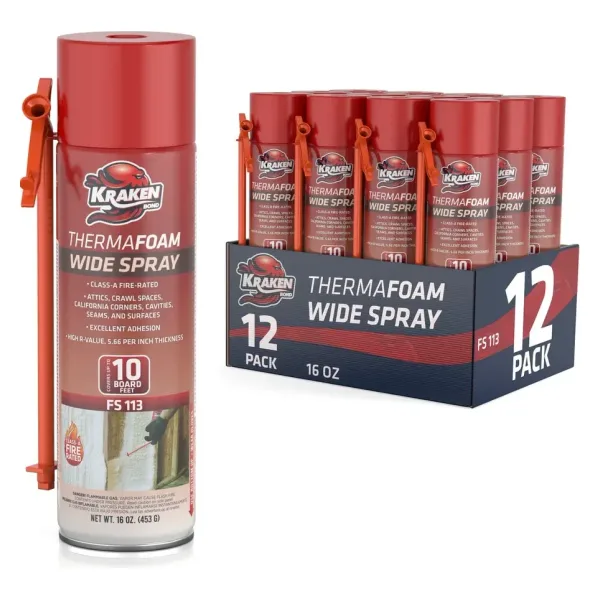
ThermaFoam leads on paperwork and on price
Ordered by what each maker publishes about its can and what the foam costs. The line on each card is what decided its position. ThermaFoam takes both: it is the only one of the three with a dated, revision-numbered data sheet, and at $0.62 an ounce it is 38 percent under the cheaper of the other two. Per claimed board foot it is about half the cost of DAP, which is the only other can here that publishes a yield at all. Value here means those two things and not a third: nothing on this page was sprayed or tested by us, so no performance is being compared. Read the four marks underneath against all of it, because DAP carries one more of them and still sits second.
As an Amazon Associate I earn from qualifying purchases. That fee never sets the order or the score.
Recommended total thickness 2 in; wide gaps, cavities and joints
One layer for air sealing, two for a full cavity, 1/2 in wet per pass; interior only
Up to 6 in wide; not for full cavity fill
Fire claim, as we read it
Class A, FSI 15 or less and SDI 40 or less to ASTM E84; no tested thickness or laboratory named
ASTM E84 flame spread 10, smoke developed 450, tested at 2.75 in; UL classified foamed plastic
Class A up to 6 in wide by 1 in thick, Intertek classified; no index values on the page
R-value claim and its basis
R-5.66 per inch, stated alongside 0.025 W/m.K to DIN 52612. Three of the four methods the FTC rule names at 16 CFR 460.5 are conductivity measurements, so the method type is not the problem: DIN 52612 is not one of the four, and no aging basis is given. The 0.025 figure taken on its own works out at R-5.77 per inch, so the sheet is printing two numbers that do not quite match
Aged R-4.1 at 1 in to ASTM C518, the only aged, method-named R-value in the tracked set
None published
Yield claim
10 board ft at 1 in per 16 oz can; recommended total thickness 2 in
Up to 11 board ft per can, theoretical; foam expands up to 3x, printed on the sheet as ASTM C1643. We cannot match that designation to an expansion or yield method; C1536 is the aerosol foam yield standard
Up to 6 in wide; two 18 oz cans cover up to 60 linear ft at a 4 in band That is a coverage figure with no thickness attached, so it cannot be compared with the board-foot claims in the other two columns.
Working range and cure
No working temperature is printed on this sheet, though the sibling Kraken cans give one; tack-free 5 plus or minus 2 min, cutting 40 min or less to ASTM C1620
Application 40 to 120 F on the data sheet; tack-free 7 to 12 min
No working temperature is published for this can; one-time use, and a partly used can may restart with a new tip within 24 h
"R-Value 5.66 (per inch thickness)." "Fire Rating Class A (FSI ≤ 15, SDI ≤ 40) (ASTM E84)." "Yield 10 board feet at 1 inch." "Recommended total thickness: 2 in."
The cheapest of the three per ounce on September 7, $119.99 for twelve 16 oz cans against $219.49 for twelve 18 oz cans of Great Stuff, and the only one with a dated data sheet. The sheet prints both E84 indices, which Great Stuff does not, and omits the tested thickness, which Great Stuff states. Its R-value comes from a German conductivity method with no aging basis stated. DAP publishes an aged figure to a US method for its own can and it is 27.6 percent lower, which is a difference between two products and two methods rather than a measurement of aging. Kraken has been asked which method and aging basis stands behind its number.
No tested thickness or laboratory for the E84 result.
R-value method and aging basis under query with the brand.
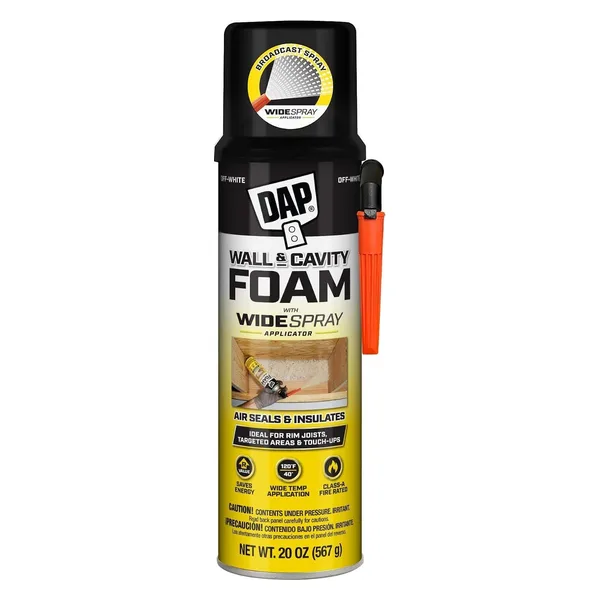
"Broadcast sprays like 2-component foam while air sealing and insulating." "ASTM C518 Aged R-Value 4.1 at 1 in." "ASTM E84 Surface Burning Characteristics (Flame/Smoke) 10/450 at 2.75 in." Interior use only.
The one can in the whole tracked set that states an R-value the way the FTC rule asks: a named ASTM method, a thickness and an aging basis, R-4.1 at 1 in aged. That is worth more than the number itself. Its E84 result carries a smoke-developed index of 450 at 2.75 in, which is the Class A ceiling, and it says so. The rating is the weakest of the three, 3.1 from 418, and the coverage guide on this site uses this product as the worked example of what an honest thermal claim looks like. The listing is DAP’s own.
Sheet has no revision date.
Amazon rating of 3.1 from 418 is the lowest of the three wide-spray cans; the pattern of complaints has not been read yet.
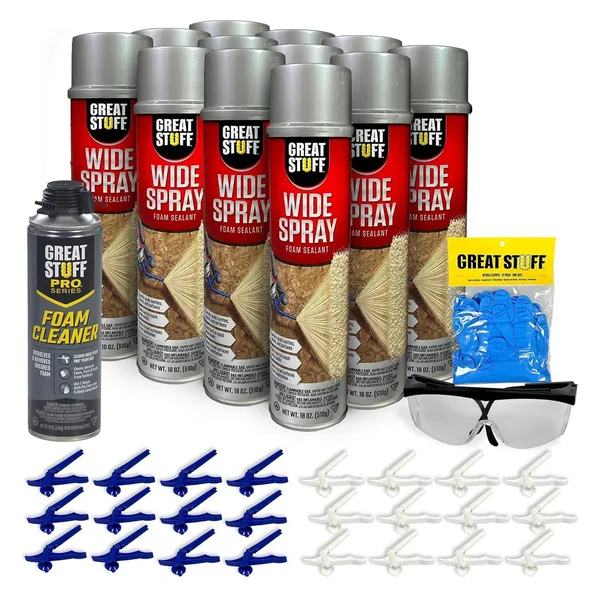
"Coats and air-seals seams, joints, large gaps, and irregular surfaces (up to 6 in wide)." "Class-A Fire Rated up to 6 in wide by 1 in thick. Intertek Classified." "Not approved for full cavity fill."
The brand that defined the format, and the one whose page says most clearly what a wide-spray can is not: not a cavity fill. Its fire claim is the only one of the three that names both a tested extent and a certifier. It is sold by DuPont on Amazon as a 12-pack of 18 oz cans. The per-ounce figure in the table below is the price per fluid ounce, calculated from that dated listing.
No data sheet; the coverage figure is a page statement.
A rim joist bay, a seam, an awkward corner, a shed wall. The can carries its own nozzle, there is nothing to clean, and the cost of a full kit is not justified. All three makers name this use.
The finishing pass after a kit
A narrow gun tip leaves edges and thin spots. A wide pattern covers them. Kraken Bond includes ThermaFoam free with its FastCoat kits of 18 cans and up, which is this role stated by a seller rather than by us.
Not a cavity fill, not a wall system
Great Stuff says its can is not approved for full cavity fill. DAP allows two layers. Neither is a substitute for a kit sized in board feet, and the three weak ratings suggest some buyers expected one.
Not listed, and why
Products we know of that are not on this page
Stanley F995 Wide Foam has a data sheet on stanleychem.com that claims R-5.66 per inch and is not yet sold in the US; it stays out of prices and comparison until it is.
Questions and answers
Wide spray foam questions, answered
Every answer comes from a maker’s data sheet, safety data sheet or manual, or from the records on this page, and says which.
01Can I insulate a whole wall, or fill a closed wall cavity, with wide spray cans?Buyer question
Two of the three makers sell their cans for open wall cavities, and none of the three describes filling a closed one. DAP’s Wall & Cavity sheet says a full cavity fill "for maximum R value" needs a two-layer application, giving a wall cavity and an attic as examples, while calling the can "Ideal for rim joists, touch-ups" or smaller repairs and projects; Kraken Bond lists walls, attics and ceilings among ThermaFoam’s uses; and both give a spraying distance from the surface, DAP approximately 12 in. Great Stuff Wide Spray is "Not approved for full cavity fill", and DuPont’s product page warns that filling enclosed voids "may cause accumulation of hazardous flammable vapors."
02How many square feet does one wide spray can cover?Buyer question
One can is rated at 10 board feet on Kraken Bond’s ThermaFoam sheet and up to 11 board ft on DAP’s Wall & Cavity sheet, and DAP defines a board foot as a 12 in by 12 in square at 1 in thick. Kraken’s figure, "10 board feet at 1 inch", is for its 16 oz can; DAP’s is for its 20 oz can, and DAP calls it theoretical, calculated in perfect laboratory conditions, with actual output affected by application method, temperature and humidity. Great Stuff Wide Spray states coverage as a run rather than an area: DuPont’s product page says two 18 oz cans cover up to 60 linear ft at a 4 in band, with no thickness given. Both board-foot figures are at 1 in thick, and Kraken recommends a total thickness of 2 in.
03Why did my wide spray foam come out thin or not expand?Buyer question
The two wide-spray data sheets set four conditions that bear on it: can temperature, humidity, can position and shaking. DAP asks for the can to be conditioned for at least 24 hours before use and for relative humidity of 40% or higher at the job, and Kraken Bond’s ThermaFoam sheet recommends a can at 68 F and warns that "Lower temperatures may reduce yield" and that any position other than valve down "will reduce foam output and efficiency". Both ask for 30 seconds or more of shaking and an upside-down can, and DAP asks for a test spray on scrap cardboard or into a trash bin before the project. Check the can’s age as well: DuPont’s safety data sheet for Great Stuff Wide Spray says to use it within 12 months, Kraken prints a shelf life of 18 months and DAP 12 months.
04Can I spray wide spray foam overhead on a ceiling?Buyer question
Kraken Bond says yes for ThermaFoam: its sheet lists "Sealing irregular, vertical, overhead, or uneven surfaces" among the uses and gives a separate spraying distance for ceilings. DAP’s Wall & Cavity sheet lists attics among its suggested uses and has a nozzle that turns for horizontal or vertical spray patterns, but it says nothing about spraying overhead. The Great Stuff Wide Spray documents we hold, a safety data sheet and DuPont’s product page, say nothing about overhead use either.
05How thick can I spray wide spray foam in one pass, and when can I add another layer?Buyer question
Of the three, only DAP’s sheet sets a per-pass limit: no more than 1/2 in of wet foam, which it says expands up to 3x to a 1.5 in cured layer. For the next layer it gives two routes: wait at least 15 minutes and until the first layer is tack-free, or mist the surface and the wet foam with water and wait 5 to 7 minutes, the method it prefers for multiple layers and maximum thickness. Kraken Bond’s ThermaFoam sheet asks for a recommended total thickness of 2 in, applied in at least 3 layers, without a per-layer figure or a wait time. The Great Stuff Wide Spray documents we hold give no layer instruction; DuPont’s Class A claim covers foam "up to 6 in wide by 1 in thick".
06Will wide spray foam stick to metal, like a garage door, shed or van?Buyer question
Two of the three makers list metal. Kraken Bond’s ThermaFoam sheet names metal among the building materials it adheres to and lists vehicle bodies, trailers and boats among its non-structural insulation uses, and DAP’s Wall & Cavity sheet says the foam bonds to "most: woods, masonry, metals and drywall". Both ask for a clean, dry surface, Kraken one free of dust, grease and rust, and Kraken does not recommend it on polyethylene, polypropylene, silicone, PTFE or oily or contaminated surfaces; DAP also marks its can "Interior use only". The Great Stuff Wide Spray documents we hold, a safety data sheet and DuPont’s product page, say nothing about which surfaces the foam bonds to.
07Which wide-spray can has the strongest fire documentation?From the records
Each states something the others do not. Great Stuff names a tested extent, 6 in wide by 1 in thick, and its certifier, Intertek, without indices. Kraken Bond prints both indices, FSI 15 or less and SDI 40 or less, without a thickness or laboratory. DAP prints both indices and the thickness, 10 and 450 at 2.75 in, and its 450 sits at the Class A ceiling for smoke.
08Why is DAP’s R-value lower than Kraken’s?From the records
The two numbers are not comparable, which is the answer. DAP states R-4.1 at 1 in as an aged value to ASTM C518, one of the four methods the FTC R-value rule accepts. Kraken states R-5.66 per inch from a DIN 52612 conductivity measurement with no aging basis stated. Different products, different methods, different conditioning: 4.1 is 27.6 percent below 5.66, and none of that gap can be assigned to aging alone without matching product, thickness and method. What it does show is that an aged, method-named figure and an unaged conductivity figure are not the same kind of number.
09Which is cheapest?From the records
Per ounce, Kraken Bond ThermaFoam: $119.99 for twelve 16 oz cans on September 7, against $219.49 for twelve 18 oz cans of Great Stuff. DAP sold a single 20 oz can at $21.60 the same day.
10Why do all three have weak ratings?From the records
DAP 3.1 from 418, Kraken 3.9 from 29, Great Stuff 4.0 from 12, against 4.0 to 4.3 for the single-can insulation kits we rate. We have not read the complaint patterns yet, so we do not know why. It is the open question on this page rather than a finding.
We have no commercial relationship with any brand on this page. As an Amazon Associate I earn from qualifying purchases. That fee never sets the order or the score. Ownership and conflicts. Nothing here was applied or tested by us; every figure names its source.
Continue to product researchSee the provisional order and evidence limits for spray foam insulation kits.