Canister and hose systems · Closed cell and open cell

Best Two-Component Spray Foam Kits

Two cylinders, a hose and a gun that mixes the chemicals in the nozzle. It is the only category on this site where a maker sells an open cell system as open cell, and the only one where a maker states in print what the yield on the box rests on. It also carries the longest safety list on the site. Eight kit families from four makers, each described in its maker's own words, side by side.

Two-component spray produces isocyanate aerosol, and every maker here says so in its own way.

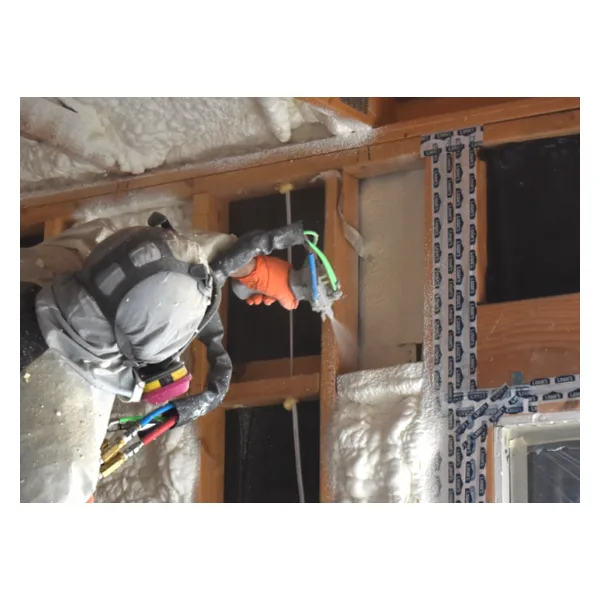
DuPont lists coveralls with no skin exposed, an organic vapor/P100 respirator and chemical-resistant gloves. HandiFoam prints "for professional use only" and names a powered air purifying respirator. Read the exact label and safety data sheet, isolate and ventilate the space, and keep unprotected people and pets out.

Open cell versus closed cell, in product terms

The decision you make before the brand

The building science lives at Spray Foam Guides, our sister publication under common ownership. Here is what the choice does to the products you can buy, read from the two HandiFoam data sheets, since HandiFoam is the only maker here that documents both.

Closed cell

  • Density 1.75 lb/ft3 free rise, over 90 percent closed cells (HandiFoam FR)
  • R-value These are not three versions of one number. HandiFoam FR prints R-6.4 aged 180 days at 75 F, at 1 in, to ASTM C518. Froth-Pak's product page calls its R-6.2 an aged LTTR, long-term thermal resistance, measured at 2 in, while its Product Information Sheet gives R-6.2 at 1 in aged 180 days at 75 F under ASTM C518, the same basis as HandiFoam's. Vega Bond says "about R-7" with no method at all. The two sheets can be compared at 1 in; the round number cannot be compared with either.
  • Fire Class A at 2 in, flame spread 10, smoke 350 (HandiFoam FR); Class A up to 2 in (Froth-Pak)
  • Vapor 0.9 perm at 1 in, which the HandiFoam FR data sheet itself calls a Class II vapor retarder. Froth-Pak's Product Information Sheet also prints a permeance to ASTM E96, at 1 in and at 2 in, with no vapor retarder class named.
  • Where it wins Rim joists, crawl space walls, foundations, anywhere moisture or a vapor retarder matters, and where the most R per inch of depth is the point
  • Kits Froth-Pak 200 and 630, HandiFoam FR II-200 and II-600, Vega Bond V200, V400, V600, Stanley F994C

Open cell

  • Density 0.75 lb/ft3 free rise, 5 percent closed cells (HandiFoam Low Density); 1 lb/ft3 stated by Vega Bond
  • R-value R-4.3 aged at 1 in to ASTM C518 (HandiFoam); R-4.4 with no method (Vega Bond)
  • Fire Class B at 4 in, flame spread 50, smoke 400, printed as such (HandiFoam); "Class A" with no indices (Vega Bond)
  • Sound STC 35, sound transmission class, how much noise the wall stops, in a stud wall with 3 in of foam; NRC 0.70 at 3 in, noise reduction coefficient, how much the surface soaks up (HandiFoam). The only sound figures on any sheet here.
  • Where it wins Interior walls and ceilings where sound matters, deep cavities where the same dollars buy more thickness, and retrofits by injection
  • Kits HandiFoam Low Density II-250, II-450, II-1350; Vega Bond Open Cell 320 and 1,100 sq ft

No single can we screened is sold as open cell. Nine of the straw and trigger cans we track carry "insulation" in a listing title, and every one of them is a gap filler rather than a cavity fill. We read listing titles and data sheets, not the printed labels. What none of those makers publishes is a closed-cell content figure, so we cannot tell you what the cell structure of any of them actually is; the one exception in our whole set is a wide-spray can that prints over 80 percent closed cells to ASTM D6226. If the job needs foam sold and documented as open cell, it needs a kit from this page. The building science of the two cell types is at Spray Foam Guides.

The part the fire class does not cover

A Class A result does not let the foam stay bare

Every kit on this page is sold for surfaces inside a building, and the code treats foam plastic on those surfaces as something that has to be covered. The surface-burning class is a separate question from the covering, and passing one does not answer the other.

Thermal barrier, the general rule

The 2021 IRC asks for foam plastic to be separated from the interior of the building by a thermal barrier: 1/2 in gypsum board, 23/32 in wood structural panel, or a material that meets the acceptance criteria of both fire tests in NFPA 275. On a basement wall or an interior stud wall, the drywall that finishes the room is that barrier. Section R316.4.

Ignition barrier, in the spaces you crawl into

Attics and crawl spaces entered only to service utilities take an ignition barrier instead, from a list of materials the code gives with the thickness for each. Sections R316.5.3 and R316.5.4. The band joist above a foundation wall is a third case again, with four numeric limits of its own in R316.5.11.

What an evaluation report changes

Section R316.6 lets an assembly go without the prescriptive barrier where it is approved on the basis of an end-use test such as NFPA 286, FM 4880, UL 1040 or UL 1715. HandiFoam and DuPont publish evaluation report numbers, ICC-ES ESR-2717 and ESR-3228, and a report covers only the exact product, thickness, substrate and geometry it names.

Class A is a flame spread and smoke result from ASTM E84 or UL 723 at a stated thickness. It is not an exemption from any of the sections above, and no maker on this page claims that it is. Your jurisdiction adopts an edition of the code and amends it, so the reading that counts is your building official's. Our crawl-space page, rim-joist page and basement page set out which case applies where.

Side by side

Eight kit families, each row in the maker's words

Scroll sideways on a phone. "Not stated" means we looked and the maker does not say. That gap is worth knowing about, so we print it rather than leaving the box empty.

DuPont Froth-Pak 200DuPont Froth-Pak 630DuPont Froth-Pak 12Stanley F994C SuperCoat Canister FoamVega Bond V200, V400, V600 closed cell kitsVega Bond Open Cell Spray Foam Insulation KitHandiFoam FR (HFO) II-200 and II-600HandiFoam Low Density II-250, II-450, II-1350
Cell typeClosed cellClosed cellClosed cellClosed cellClosed cellOpen cellClosed cellOpen cell
SizesOne kit: ISO (A) and polyol (B) cylinders, Insta-Flo gun, 8 cone and 4 fan nozzles, wrench, petroleum jelly, 9 ft gun hose assemblyOne kit with the same contents as the 200 and a 15 ft gun hose assembly; a 30 ft assembly version is sold on AmazonSmall two-component sealant kit with a 3 ft hose, sold in packs of 2, 4 and 12200 board feet kit and 600 board feet kit, two canisters eachV200 (200 board feet, 9.5 ft hose), V400 (400 board feet), V600 (600 board feet, 15 ft hose); slow-rise V200 SLR and V600 SLR for drill-and-fill; each with gun and hose, gloves, coverall, glasses and nozzles320 sq ft coverage kit with 10 ft hose; 1,100 sq ft coverage kitII-200 (201 board feet) and II-600 (601 board feet) disposable kits; refillable systems from 8 to 120 gallonsII-250 (250 board feet), II-450 (450 board feet), II-1350 (1,350 board feet) disposable kits
Yield claim200 sq ft at 1 in630 sq ft at 1 inNot stated on the Amazon listing we read; the frothpak.dupont.com products page lists only the 200 and 630Up to 200 board feet, or 600, at 1 in200, 400 or 600 board feet at 1 in320 or 1,100 sq ft201 and 601 board feet250, 450 and 1,350 board feet
How the maker defines the yield"The theoretical yield has become an industry standard for identifying certain sizes of two-component kits. Theoretical yield calculations are performed in laboratory conditions, without taking into account the loss of blowing agent or the variations in application methods and types."Same theoretical-yield definition as the 200None found"Covers up to" on the retail page; no theoretical-yield definition"Covers up to" on the store; no definition of the figureStated as coverage; thickness not stated on the store"Yield is based on free-rise density ... Applying foam into a cavity may result in higher in-place densities due to packing effects. These higher densities may result in lower yields."Free-rise density basis with the same packing caveat as the FR sheet
R-value claimR-6.2 per inch; 12.2 at 2 inR-6.2 per inch; 12.2 at 2 inNot statedR-6.27 per inchAbout R-7 per inchR-4.4 per inchR-7.0 initial and R-6.4 aged 180 days at 75 F, both at 1 inR-4.3 at 1 in, aged 90 days at 140 F
Reading the R-valueTwo published results at two thicknesses, each measured at its own sprayed thickness under ASTM C518 and aged 180 days at 75 F, by the Product Information Sheet. Read each at the thickness it names; do not multiply the 1 in figure to get the 2 in one.Two published results at two thicknesses, on the same basis as the 200 kit: each measured at its own sprayed thickness.No R-value is published for this kit at all. The Froth-Pak 200 and 630 figures belong to a different product and do not transfer to it.One per-inch figure with no test method and no aging basis behind it, so there is nothing to check it against and nothing that says how it would behave at another thickness.An approximate per-inch figure, given as “nearly” and “approximately”, with no method. Read it as a round number rather than a measurement.One per-inch figure from a store page, with no thickness, method or aging basis attached.Two results at the same thickness, one initial and one aged 180 days at 75 F. The aged figure is the one to plan with, and the pair is here because the sheet prints both.One aged figure at one thickness. Note the aging condition, 90 days at 140 F, is not the condition on the FR sheet, so the two aged numbers are not measured the same way.
R-value basisProduct page: "aged LTTR measured at 2-in. thick". Product Information Sheet: ASTM C518, aged 180 days at 75 F, sprayed at 1 in and at 2 inSame as the 200: "aged LTTR measured at 2-in. thick" on the page; ASTM C518, aged 180 days at 75 F at 1 in and 2 in, on the Product Information SheetNone foundStated on the retail page with no method or aging basis"Nearly R-7" and "approximately R-7" on the store, no method or aging basisStore statement; no method or aging basisASTM C518, initial and aged values both printedASTM C518, aged value printed
Vapor permeance5.4 perm at 1 in and 3.1 perm at 2 in, ASTM E965.4 perm at 1 in and 3.1 perm at 2 in, ASTM E96Not statedNot statedNot statedNot stated0.9 perm at 1 in, which the sheet itself calls a Class II vapor retarderNot stated
Fire claimClass A fire rated up to 2 in thick on the page; ICC-ES ESR-3228 gives flame spread 25 or less and smoke developed 450 or less at a maximum of 2 in; the exact indices are not publishedClass A fire rated up to 2 in thick on the page; ICC-ES ESR-3228 gives flame spread 25 or less and smoke developed 450 or less at a maximum of 2 in; the exact indices are not publishedNot stated on the listingClass A, ASTM E84 "certified for minimal smoke and fire spread"; no indices. Nothing is certified to ASTM E84: it is a test method that returns two numbers, and neither is printed here"ASTM E84 Approved Class A Building Material (Lowest Fire Spread Rate and Minimal Smoke Production)"; no indices. A product is not approved to ASTM E84, and Class A is not the lowest flame spread rate, it is a band that runs from 0 to 25"ASTM E84 Class A Rated, low flame spread and smoke"; no indices. The class is stated without the two numbers that produce itClass A: ASTM E84 flame spread 10, smoke developed 350, tested at 2 in; CAN/ULC-S102 at 4 in beads FSI 15, SDI 75; ICC-ES ESR-2717ASTM E84 flame spread 50, smoke developed 400, tested at 4 in: Class 2 (B), stated as such
DensityNot statedNot statedNot statedNot statedNot stated1 lb/ft3, stated as higher than "standard half-pound open-cell foam"1.75 lb/ft3 free rise, 2.10 in place; closed-cell content over 90 percent0.75 lb/ft3 free rise, 1.12 in place; closed-cell content 5 percent
CureProduct page: 30-second cure time and 1-hour re-entry with proper ventilation. Operating manual, Rev 04/2026: tack free within 60 seconds, fully cured in five minutesProduct page: 30-second cure time and 1-hour re-entry with proper ventilation. Operating manual, Rev 04/2026: tack free within 60 seconds, fully cured in five minutesNot stated on the listingTack-free in about 30 seconds; fully cured within 24 hours; re-entry 1 hour after application with proper ventilationSlow-rise version tack-free in about 3 minutes; fast-rise not statedNot statedTack-free 15 to 30 seconds; occupants can re-enter one hour after spraying once the area is ventilated (operating instructions A16600)Tack-free 30 to 45 seconds
Hose9 ft (200); 15 ft (630); 30 ft assembly sold separately15 ft; 30 ft version listed on Amazon3 ft10 ft hose and gun set in the box; 10 ft and 15 ft replacement assemblies sold separately at $89.999.5 ft (V200); 15 ft (V600); 10 ft and 15 ft assemblies sold separately10 ft with the 320 kitDisposable kit hose; length not stated on the sheetDisposable kit hose; length not stated on the sheet
Reuse and shelf lifeReusable for 30 days after opening. The operating manual states storage temperatures but no shelf-life duration.Reusable for 30 days after opening. The operating manual states storage temperatures but no shelf-life duration.Not statedUsable for up to 30 days after first useNot statedNot statedShelf life 12 months; use the contents within 30 days of first use, dispensing a little at least every 3 days (operating instructions A16600)Shelf life 12 months
PPE the maker namesProtective clothing or impermeable coveralls with no skin exposed, goggles or safety glasses, respirator with organic vapor/P100 cartridge, chemical-resistant gloves (nitrile, butyl, neoprene or PVC); anyone within 25 ft of the applicator needs respiratory protection too; "For Professional Use Only" (Product Information Sheet)As the 200: coveralls, eye protection, organic vapor/P100 respirator, chemical-resistant glovesNot stated on the listing, and we found no label or safety data sheet for this kit. We are not transferring the 200 and 630 list to it: protective equipment follows the exact product’s own label and SDS.A PPE kit in the box: coverall suit, safety glasses and nitrile gloves. The retail page also says to wear a respirator, goggles, gloves and coveralls; the packing list names no respiratorGloves, coverall and safety glasses included in the kit; the store also sells half-mask respirators and organic vapor/P100 cartridges separatelyNot stated on the open cell page"Certified respiratory protection or a powered air purifying respirator (PAPR)," glasses with side shields or goggles, nitrile gloves, protective clothing; "FOR PROFESSIONAL USE ONLY"As the FR sheet: certified respiratory protection or PAPR, eye protection, nitrile gloves, protective clothing; professional use only
Who the maker says it is for"The all-in-one, self-contained, disposable kit for professional contractors"; ESR-3228 requires installers certified by DuPont or SPFA"Particularly well-suited for bigger applications such as larger renovation projects or cold storage insulation"Sealant use, not insulation, by its name"Designed primarily for professional contractors"Homeowners and contractors, by the store copy"DIY users and contractors alike""For professional use only," printed on the sheet"For professional use only"
DocumentsPAGE · TDS, 2025 · MANUAL, Rev 04/2026 · ESR, Reissued January 2026PAGE · TDS, 2025 · MANUAL, Rev 04/2026 · ESR, Reissued January 2026None foundPAGEPAGEPAGETDS, Rev 07/2024-9 · SDS, November 9, 2022 · SDS, July 25, 2022 · MANUAL, Rev 11/2024TDS, Rev 6/2024 · SDS, September 2018 · SDS, February 2018
Amazon, September 7, 2026200 kit, 9 ft hose: $409.00, 3.9 rating from 19 ratings630 kit, 15 ft hose: $989.00, 4.4 rating from 55 ratings, 100+ bought in past month12 kit, pack of 2 on September 8 (pack of 4 in the September 7 title): $217.49, 3.6 rating from 4 ratingsNo Amazon listing foundNo Amazon listing foundOpen cell kit, with hose and gun: $399.99, no rating from 0 ratingsHandi Foam E84 Class 1 low pressure kit: no price, 3.3 rating from 16 ratingsOpen cell kit, pack of 4: $2102.79, 3.5 rating from 2 ratings
Brand storeNot readNot readNot read$349.99 for the 200 kit and $899.95 for the 600 kit on the retail store, both out of stock on September 8, 2026V200 $399 and V600 $799.99, both out of stock with "more stock September 14th"; V400 $549.99 out of stock; V200 SLR $429.99 in stock, on September 8, 2026$399.99 for the 320 sq ft kit and $799.99 for the 1,100 sq ft kit, both in stock on September 8, 2026Not readNot read
Price per stated unit$2.04 per stated square foot, from the Amazon listing we track for this kit$1.57 per stated square foot, from the Amazon listing we track for this kitNo figure: the listing is a multi-kit pack, so its price does not divide by one kit yieldNo figure: this kit has no Amazon listing, so there is no price to divideNo figure: this kit has no Amazon listing, so there is no price to divideNo figure: the listing is a multi-kit pack, so its price does not divide by one kit yieldNo figure: the listing carries no priceNo figure: the listing is a multi-kit pack, so its price does not divide by one kit yield

The records

What each maker claims, what it documents, and what we make of it

As an Amazon Associate I earn from qualifying purchases. That fee never sets the order or the score.

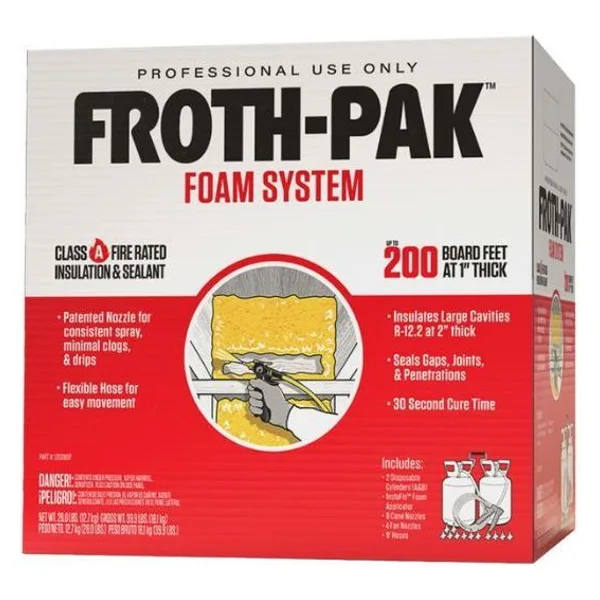
DuPont Froth-Pak 200 Foam System kit
Closed cell

DuPont Froth-Pak 200 Foam System

One kit: ISO (A) and polyol (B) cylinders, Insta-Flo gun, 8 cone and 4 fan nozzles, wrench, petroleum jelly, 9 ft gun hose assembly

"Froth-Pak 200 Insulation and Sealant covers 200 square feet at 1 inch thickness. Provides an R-value of 6.2 at 1 inch thick and 12.2 at 2 inches thick. 30-second cure time and 1-hour room reentry."
frothpak.dupont.com product page, read September 8, 2026

The benchmark of the category and one of two makers here that define in print what their yield number rests on. DuPont says the theoretical yield is calculated in laboratory conditions, without accounting for blowing-agent loss or variation in application method. HandiFoam does the same job in different words, basing its figure on free-rise density and warning that packing into a cavity raises the density and lowers the yield. Its Product Information Sheet names the R-value test, ASTM C518, and prints the aged results at 1 in and at 2 in, which the product page alone did not. The page names the PPE a user needs in one list. What no DuPont document prints is the E84 indices behind "Class A"; the ICC-ES report gives only the code ceilings of 25 and 450.

Documents on file

Open questions

  • The product page links no data sheet, and no DuPont document publishes the E84 indices.
  • Nineteen ratings on Amazon for the 200 kit against fifty-five for the 630.

Other listings, September 7, 2026

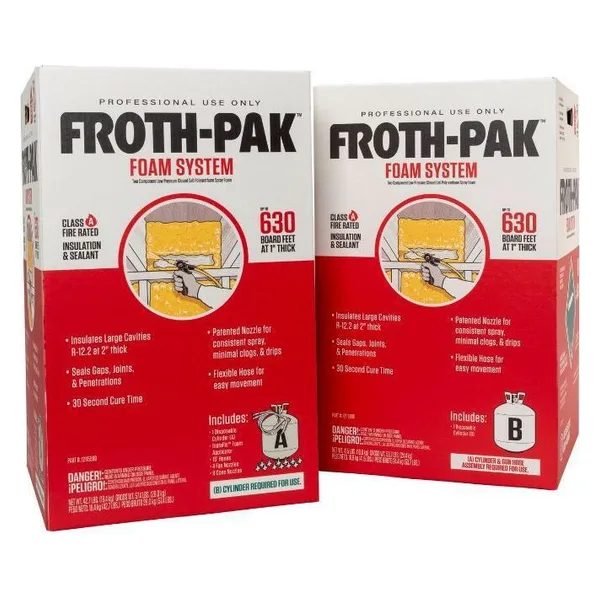
DuPont Froth-Pak 630 Foam System kit
Closed cell

DuPont Froth-Pak 630 Foam System

One kit with the same contents as the 200 and a 15 ft gun hose assembly; a 30 ft assembly version is sold on Amazon

"Froth-Pak 630 Insulation and Sealant covers 630 square feet at 1 inch thickness. Provides an R-value of 6.2 at 1 inch thick and 12.2 at 2 inches thick."
frothpak.dupont.com product page, read September 8, 2026

Among the two-component listings we tracked on September 8, 2026, this one carried the largest Amazon buying signal: fifty-five ratings and a "100+ bought in past month" badge on the 15 ft version. Per stated square foot it is cheaper than the 200: $989 for 630 sq ft against $409 for 200 sq ft, about $1.57 against $2.05 per theoretical square foot. Same documents as the 200, and the same missing E84 indices.

Documents on file

Open questions

  • The product page links no data sheet, and no DuPont document publishes the E84 indices.

Other listings, September 7, 2026

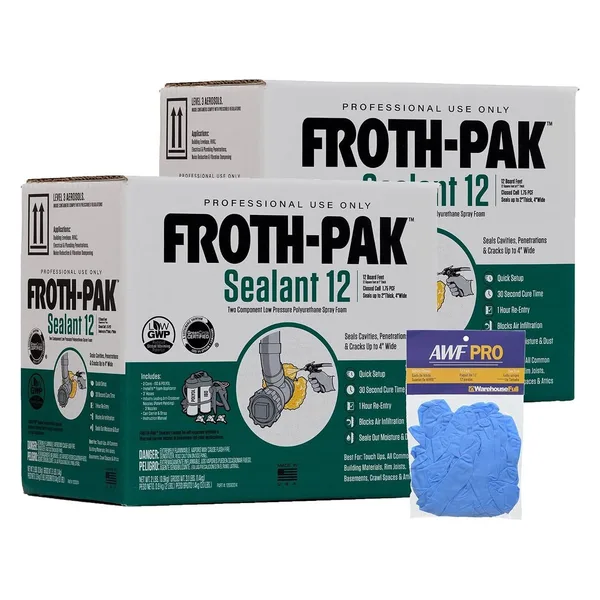
DuPont Froth-Pak 12 Spray Foam Sealant Kit kit
Closed cell, not stated

DuPont Froth-Pak 12 Spray Foam Sealant Kit

Small two-component sealant kit with a 3 ft hose, sold in packs of 2, 4 and 12

DuPont does not state a cell type for this kit. We have grouped it with the closed-cell Froth-Pak systems because it is the same product line, and that placement is our inference, not a published figure.

"Froth-Pak 12 Spray Foam Sealant Kit, 3 ft Hose"
Amazon listing title, read September 8, 2026

DuPont sells this one on Amazon and does not list it on its own products page. Two listings, six ratings between them, a pack size that changed overnight and a rating that doubled. We list it because the intake caught it; there is nothing to check it against.

Documents on file

Nothing on file.

Open questions

  • Not on frothpak.dupont.com; no document found.
  • Pack size and rating on B096N4S4VV changed between September 7 and 8.

Other listings, September 7, 2026

Stanley F994C SuperCoat Canister Foam 200 and 600 kit
Closed cell

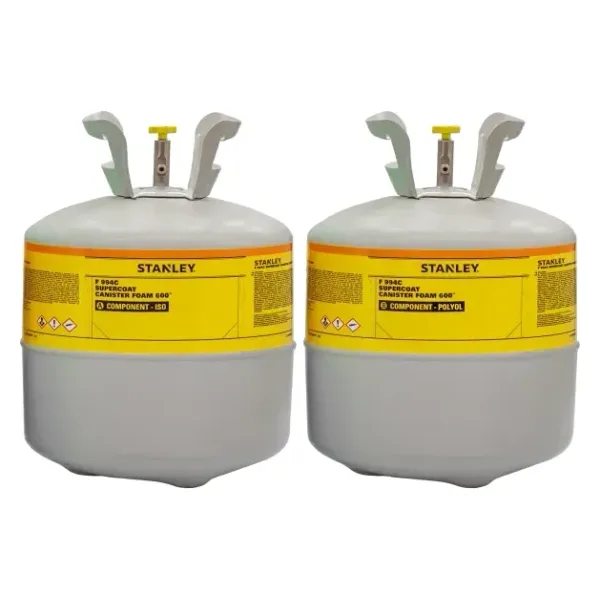
Stanley F994C SuperCoat Canister Foam 200 and 600

200 board feet kit and 600 board feet kit, two canisters each

No Amazon listing found Full record, documents and cost
"Class-A fire rated and boasting an R-value of 6.27 per inch ... covers up to 200 board feet (at 1-inch thickness)."
oneclickdiy.com retail page, read September 8, 2026

The canister sibling of a kit we rate, with the retail copy of a finished product and the paper of an unreleased one: a 6.27 R-value with no method behind it, a Class A claim with no indices, no data sheet on a documents page that has one for every other Stanley foam, no Amazon listing, and both sizes out of stock. The brand’s own product page for the canister system carries the single-can SuperCoat text, describing a "one component" foam that yields "up to 20 board feet" per layer, which is the F990P can, not a two-canister kit. It stays in the table so the comparison is complete. It cannot be recommended on what is published.

Documents on file

Open questions

  • No TDS or SDS on stanleychem.com.
  • The stanleychem.com F994C page describes a one-component can; the two-component copy exists only on the retail store.
  • No Amazon listing; only replacement hoses are sold there.
  • Both kit sizes out of stock on the retail store.
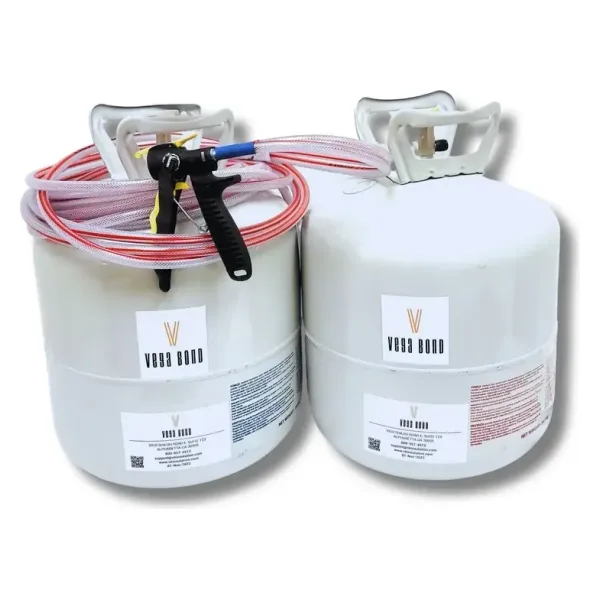
Vega Bond V200, V400 and V600 Closed Cell Kits kit
Closed cell

Vega Bond V200, V400 and V600 Closed Cell Kits

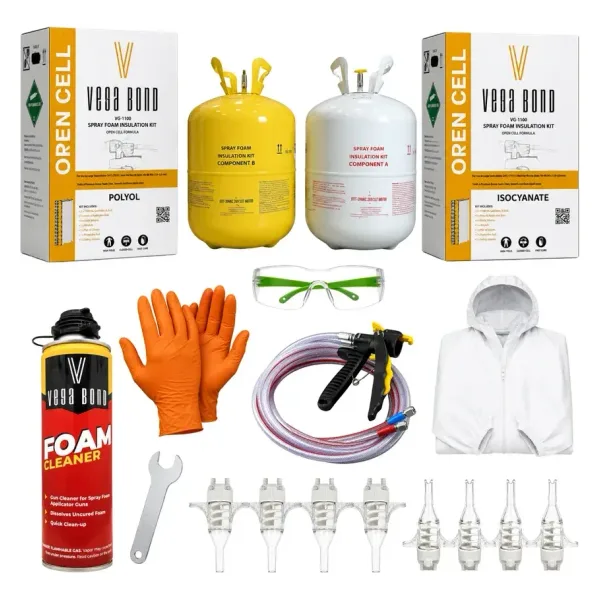
V200 (200 board feet, 9.5 ft hose), V400 (400 board feet), V600 (600 board feet, 15 ft hose); slow-rise V200 SLR and V600 SLR for drill-and-fill; each with gun and hose, gloves, coverall, glasses and nozzles

No Amazon listing found Full record, documents and cost
"R-Value R-7 per inch. ASTM E84 Approved Class A Building Material ... Stops Mold and Moisture. Completely seals out unwanted air leaks."
vbinsulation.com product pages, read September 8, 2026

Nobody else covers this many sizes: closed and open cell, fast and slow rise. It ships gloves, a coverall and glasses in the box, as Stanley’s canister kit does, and sells respirator cartridges on the same store. Every performance figure is a store statement: R-7 with no method, Class A with no indices, board feet with no definition. No sheet, no SDS, and no Amazon listing for the kits themselves; only the nozzles and hoses are on Amazon.

Documents on file

Open questions

  • No TDS or SDS published.
  • Kits not found on Amazon; accessories only.
  • V200 and V600 out of stock on September 8.
Vega Bond Open Cell Spray Foam Insulation Kit kit
Open cell

Vega Bond Open Cell Spray Foam Insulation Kit

320 sq ft coverage kit with 10 ft hose; 1,100 sq ft coverage kit

"Vega Bond features a 1 lb/ft3 density, providing stronger sound absorption and improved thermal performance, with an R-Value of 4.4 per inch ... Acts as an air barrier at 2 inches."
vbinsulation.com product page, read September 8, 2026

One of two open-cell kits among the products we tracked as of September 8, 2026, and the one that states a density and an air-barrier thickness. The R-4.4 figure is close to what HandiFoam prints from a named ASTM test for its lower-density open cell, which is worth noticing; Vega Bond gives no method. Coverage is stated without a thickness, so the two kit sizes cannot be turned into board feet from the page alone.

Documents on file

Open questions

  • Coverage stated without thickness.
  • No document of any kind.
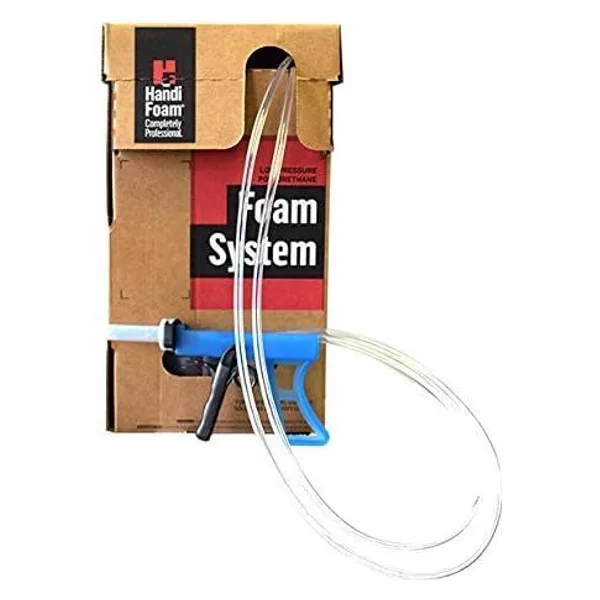
HandiFoam FR (HFO) II-200 and II-600 kit
Closed cell

HandiFoam FR (HFO) II-200 and II-600

II-200 (201 board feet) and II-600 (601 board feet) disposable kits; refillable systems from 8 to 120 gallons

"Low pressure, medium density, two-component spray polyurethane foam ... Conforms to the requirements of ASTM E84 as a Class 1 (A) system."
HandiFoam technical data sheet TD052, rev. 07/2024-9

The most completely documented product in this entire category. It prints an initial and an aged R-value with the test named, both surface-burning indices with the tested thickness, a code evaluation report number and a yield definition that explains why in-place foam yields less. DuPont’s Product Information Sheet matches it on the R-value test and the report number; only HandiFoam’s sheets print the surface-burning indices. It also says, in capitals, that it is for professional use only, and it names a PAPR. That is the honest version of what a two-component kit is.

Open questions

  • The one Amazon listing has 16 ratings and a title that does not say which kit it is.
  • Hose length is not on the sheet or in the operating instructions.
HandiFoam Low Density (open cell) II-250, II-450 and II-1350 kit
Open cell

HandiFoam Low Density (open cell) II-250, II-450 and II-1350

II-250 (250 board feet), II-450 (450 board feet), II-1350 (1,350 board feet) disposable kits

"Low pressure, low density, two-component spray polyurethane foam. Designed to fill and seal various size voids, deaden sound or reduce vibration." STC 35 and NRC 0.70 at 3 in.
HandiFoam technical data sheet A16531, rev. 6/2024

The only open-cell product in the category with a data sheet, and the sheet is candid where others are not: the fire result is a Class B at 4 in, printed as such, the R-value is aged, and the sound numbers that sell open cell, STC 35 and NRC 0.70, come with a thickness and an assembly type rather than floating free. It also describes the test wall: 5/8 in OSB outside, one layer of type X gypsum inside, 2 by 4 studs and 3 in of foam. It gives no stud spacing and no reading for the same wall without foam, so the share of the 35 that belongs to the foam is not stated. A buyer who reads this sheet and the FR sheet together has a useful start on the open-versus-closed question, not the whole decision.

Open questions

  • Only one Amazon listing, a four-pack at $2,102.79 with two ratings.
  • Hose length not on the sheet.

What matters before the headline number

Four things that decide whether the yield on the box reaches the wall

Mix ratio

Off-ratio foam stays soft, shrinks, smells or fails to cure. The Froth-Pak operating manual says to replace a nozzle after more than 50 seconds idle at 70 to 75 F, 35 seconds at 80 F, or 30 seconds at 85 F.

Chemical temperature

The Froth-Pak instructions ask for tank contents at 75 F or warmer. The HandiFoam operating instructions ask for core chemical at 75 to 85 F. Both makers warn that output drops as the chemical gets colder, which is the most common reason a kit runs out early.

Yield is theoretical

DuPont and HandiFoam both say what the number rests on. DuPont calls it a theoretical yield calculated in laboratory conditions; HandiFoam bases its on free-rise density and says packing into a cavity raises the density and lowers the yield. Plan on less.

Controls are part of the product

PPE, isolation, ventilation, re-entry and re-occupancy limits come from the exact product's label and safety data sheet, and from local requirements. Only one number of this kind appears anywhere on this page: DuPont's one-hour room re-entry with proper ventilation. That is a figure for a protected applicator. No maker here publishes a figure for when unprotected people can move back in, so do not read the one-hour line as that number.

Questions and answers

Two-component kit questions, answered

Every answer comes from a maker’s data sheet, safety data sheet or manual, or from the records on this page, and says which.

Ask your own
  1. Froth-Pak 200, 620, 630 or 650: which one do I need? Buyer question

    The DuPont documents we hold describe two disposable kits by number, the Froth-Pak 200 and 630, as one foam system in two sizes, and none of them names a 620 or 650. DuPont’s product information sheet lists their theoretical yields as 200 and 630 board feet at 1 in, from kits that weigh 39 lb and 111 lb; its operating manual sets the 200 up from a single box, while the 600-series kit arrives as a boxed A tank, a boxed B tank and a boxed gun and hose kit. The site’s records list a 9 ft hose on the 200 and a 15 ft hose on the 630, with a 30 ft assembly sold separately. Above the kits, the sheet lists refillable cylinders rated from 2,072 board feet for the Froth-Pak 17 to 15,563 for the Froth-Pak 120, and the Froth-Pak 12 sold on Amazon is a sealant kit with a 3 ft hose for which DuPont publishes no yield or R-value.

  2. Can I stop a Froth-Pak kit and use the rest later, and does it expire? Buyer question

    Yes, within 30 days of opening: DuPont’s Froth-Pak operating manual says to "use kit within 30 days of opening," and HandiFoam’s operating instructions say "Use contents within 30 days of initial use." To store a part-used Froth-Pak, the manual says to shut both cylinder valves, leave the hoses pressurized, clean the end of the gun, reapply petroleum jelly and "Re-insert a used nozzle," purge the system every two weeks if it sits, and on restart remove that cured nozzle and fit a new one. HandiFoam asks instead for a little foam to be dispensed "at least once every three (3) days" and says not to flush or clean the hoses "with air, water or solvent." For an unopened kit, the Froth-Pak manual points to the "Use by date on carton lid," and HandiFoam’s FR sheet prints a 12-month shelf life.

  3. How warm do two-component spray foam tanks need to be, and how do I warm them? Buyer question

    Both makers set the temperature of the chemical, not just the room: DuPont’s Froth-Pak manual says the tank contents should be at 75 F or warmer, and HandiFoam’s FR sheet says to condition the chemical to 75 to 85 F. The method both print is time in a warm room: Froth-Pak says to store the kit indoors at 75 to 85 F "for at least one day prior to spraying," and HandiFoam’s instructions give kits stored below 70 F "1-2 days" to warm up, longer for the larger systems. Air and surface limits differ: Froth-Pak asks for 65 F or above and gives a thin flash-coat method for colder work because below that "foam shrinkage may occur," while HandiFoam’s sheet allows 40 to 100 F for both. DuPont also notes that the indicator on the tank shows "the contents of the tank, not the ambient air temperature," and its manual refers to a "Section 11, Tank Heating" that the April 2026 edition does not contain, so neither maker prints a tank-heating method.

  4. Why is my two-part spray foam soft, sticky, shrinking or coming out like popcorn? Buyer question

    Both makers read those symptoms as off-ratio foam, with one side of the kit flowing faster than the other. DuPont’s Froth-Pak manual says foam that "will not cure completely, is soft to the touch or sags" means the B tank is outrunning the A tank, and foam that looks "brittle and flaky" with honeycomb areas means the reverse; HandiFoam’s troubleshooting guide pairs "White spongy or shrinking foam" with too much B and "Dark crunchy foam" with too much A. The causes they list are cold chemical, a clogged nozzle or a blocked port at the gun face, and a kit running low, and DuPont adds that a partly squeezed trigger "can result in off ratio foam." DuPont’s fix is to check that the tanks are at least 75 degrees, clear the gun face, purge until both streams run even and fit a new nozzle; HandiFoam’s guide asks for chemical at 70 to 85 F and a new nozzle or a cleaned gun face.

  5. Froth-Pak or Handi-Foam: how do the kits compare, and is either one a vapor barrier? Buyer question

    Of the two-component brands buyers compare, the site holds documents for DuPont’s Froth-Pak and HandiFoam’s FR (HFO) kits; it has no record for Tiger Foam, Foam It Green or a Touch ’n Seal two-component kit, so those cannot be compared here. Both sheets print a density of 1.75 lb/ft3 and an R-value at 1 in aged 180 days at 75 F to ASTM C518: 6.2 for Froth-Pak and 6.4 for HandiFoam. On fire, HandiFoam’s sheet prints flame spread 10 and smoke developed 350 tested at 2 in, while DuPont’s ICC-ES report gives only "25 or less" and "450 or less" at a maximum of 2 in. On vapor, HandiFoam prints "0.9 perms - Class II Vapor Retarder" at 1 in, while Froth-Pak’s sheet prints 5.4 perm at 1 in and 3.1 at 2 in and gives the foam no vapor retarder class; DuPont’s report adds that a vapor retarder must be installed when the applicable code requires one, which the local code official decides.

  6. Can I leave two-part spray foam uncovered on a rim joist, in a crawl space or on a basement wall? Buyer question

    On a rim joist, DuPont’s ICC-ES report ESR-3228 allows Froth-Pak to stay uncovered: up to 2 in thick it "may be applied to sill plates, band joists and headers without a thermal barrier or ignition barrier" in Type V construction. Elsewhere, such as on a basement wall, the same report requires a thermal barrier of 1/2 in gypsum wallboard or an equivalent unless a listed fire protective coating is applied, and in an attic or crawl space entered only to service utilities it requires an ignition barrier unless its listed conditions and coating are met. The report also says the foam must not be used where it may contact heat-conducting surfaces such as heaters, furnaces, chimneys or vents, DuPont’s sheet says not to expose it to temperatures over 240 F, and the report requires installers certified by DuPont or SPFA. HandiFoam’s FR sheet cites ICC-ES ESR-2717, which is not in our set, and names NFPA 286 testing at 2 in thick by 6 in wide for roof/wall junctions and attic/wall penetrations without a thermal barrier. Whether a particular basement or crawl space meets these conditions is for the local code official to decide.

  7. What is a two-component spray foam kit? From the records

    Two pressurized cylinders, an A side (isocyanate) and a B side (polyol), joined by hoses to a gun where they mix in a disposable nozzle and react into foam within seconds. The chemistry happens as you spray, so mix ratio, chemical temperature and nozzle condition decide the result. Every maker on this page ships the kit with cylinders, hose, gun and nozzles; some add gloves and a coverall.

  8. Is there a single-can open cell foam? From the records

    No. Across the 496 products we screened in September 2026, every open cell product is a two-component or hose system: Vega Bond and HandiFoam kits, an injection retrofill kit, and nozzles. Open cell versus closed cell is a decision you make on this page, not on the single-can kit page.

  9. Which kit publishes the most complete numbers? From the records

    HandiFoam. Its FR (HFO) sheet prints an initial and an aged R-value to ASTM C518, both E84 indices with the tested thickness, an ICC-ES evaluation report number and a yield definition. Its Low Density sheet does the same for open cell and states a Class B fire result plainly. DuPont defines its theoretical yield and states an aged R-value on its web page without a linked sheet. Vega Bond and Stanley publish store statements only.

  10. Why does the open cell kit publish a lower R-value and a different fire class? From the records

    Read them as separate published results rather than one cause. On HandiFoam’s two sheets the low-density foam cures at 0.75 lb per cubic foot with 5 percent closed cells and prints R-4.3 aged at 1 in and an E84 result of 50 and 400 at 4 in, which its sheet calls Class 2 (B). The FR foam cures at 1.75 lb per cubic foot with over 90 percent closed cells and prints R-6.4 aged at 1 in and 10 and 350 at 2 in, Class 1 (A). Density, formulation, blowing agent and the tested thickness all differ between them, so no single one of those explains the gap. The low-density sheet is also the only one here that prints sound figures.

  11. How much does a two-component kit cost per board foot? From the records

    Only where the listing and the kit size line up. Froth-Pak 630 is $989 for a stated 630 sq ft at 1 in, about $1.57; Froth-Pak 200 is $409 for 200 sq ft, about $2.04. Three kits give no figure, for three different reasons. The HandiFoam FR listing carries no price. The HandiFoam Low Density listing is a pack of four whose title does not say which system size is inside. The Vega Bond closed-cell kits and the Stanley canister have no Amazon listing at all, so only their brand-store prices are on this page, quoted as text. The Vega Bond open-cell kit does have a listing at $399.99. Every one of these yields is the maker’s theoretical figure, and two of the four makers say in print that it is a laboratory number.

  12. Are two-component kits for DIY use? From the records

    The makers answer differently. DuPont calls Froth-Pak a kit "for professional contractors." HandiFoam prints "FOR PROFESSIONAL USE ONLY" and names a powered air purifying respirator. Vega Bond addresses "DIY users and contractors alike" and ships gloves, coverall and glasses. Stanley says "primarily for professional contractors." Read the PPE list on this page before deciding. Two clocks matter here and they are not the same one: how soon a worker in full gear can go back in, and how soon everybody else can.

Read before you buy

The guides this page leans on

Spray Foam Guides is our sister publication under common ownership. We have no commercial relationship with any brand on this page. As an Amazon Associate I earn from qualifying purchases. That fee never sets the order or the score. Ownership and conflicts. Nothing here was sprayed or tested by us. Every figure in the comparison table names the document it came from, and the dated sources for each kit are listed in its record above.

Continue to product researchSee the provisional order and evidence limits for spray foam insulation kits.
Compare insulation kits