A buyer's question, answered from the records
How long does spray foam take to cure?
The short answer
On their own sheets, the one-component spray foam kits we track are tack-free in 3 to 10 minutes, ready to trim in about 40 minutes, and 4 of the 5 put a full cure at 24 hours. Two-component kits set far faster, tack-free in 15 seconds to 3 minutes. On re-entry, none of the 5 one-component kits publishes a time for going back in, while 3 two-component makers give 1 hour with ventilation.
Product examples · not ranked
The cans this answer is about
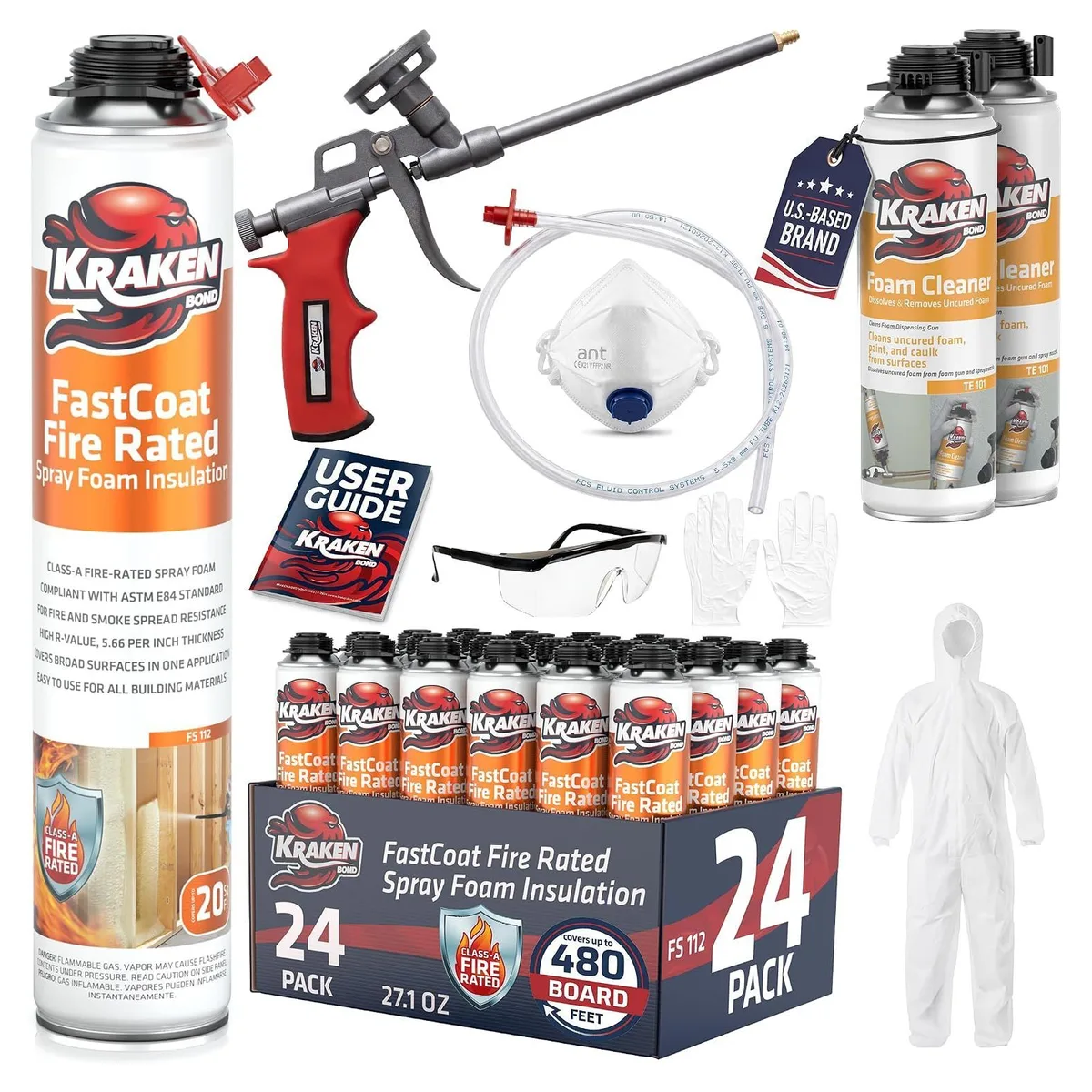 Kraken Bond FastCoat 24-PackSee it on Amazon
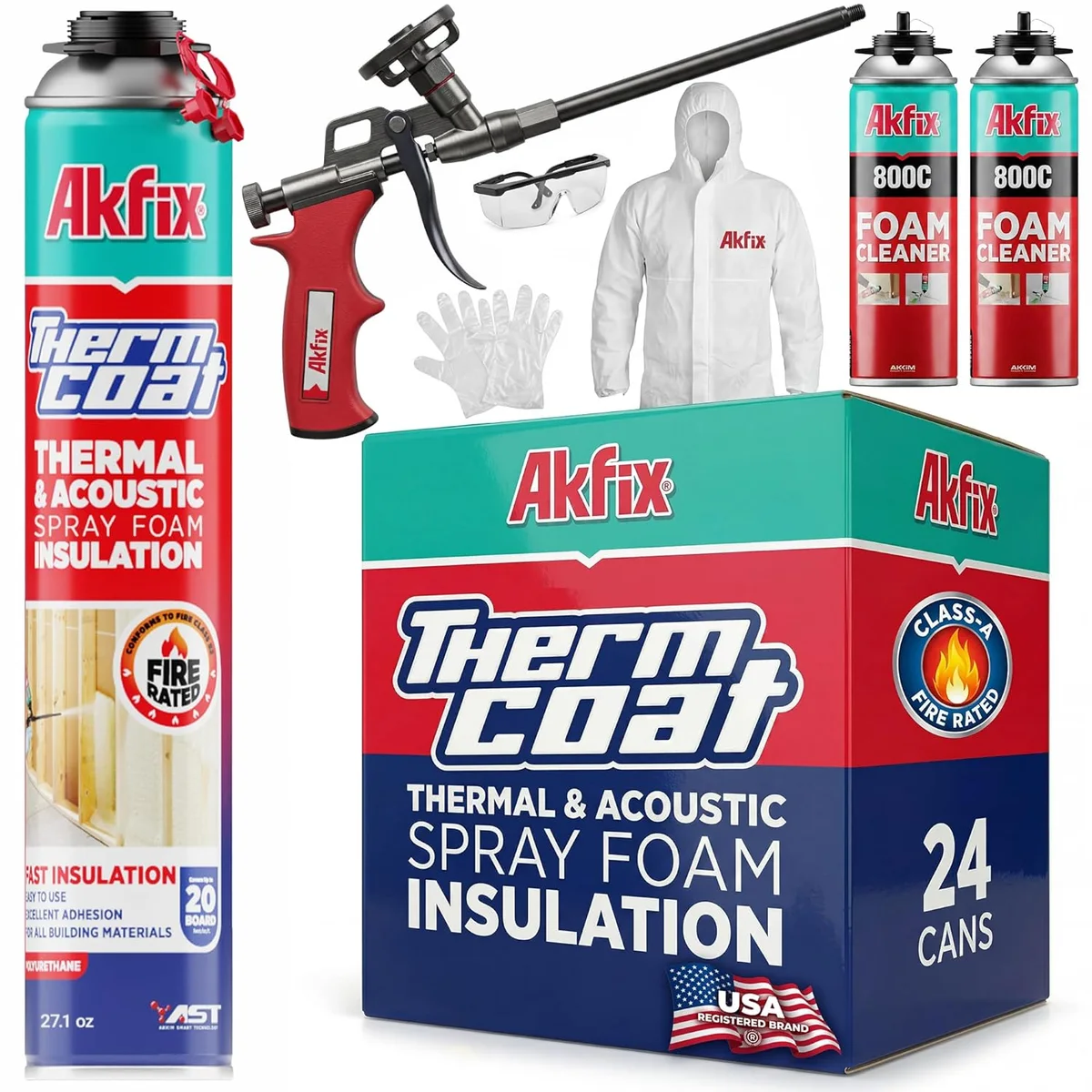 Akfix ThermCoat 24-PackSee it on Amazon
- StanleyStanley F990P SuperCoat Complete 12-pack kitSee it on Amazon
As an Amazon Associate I earn from qualifying purchases.
What the records show
One-component spray foam kits
The canned kits a DIY buyer sprays from a gun. Each row is the maker’s own figure, from the document named in the last column.
| Product | Tack-free | Ready to trim | Full cure | Next layer | Back in the room | From |
|---|---|---|---|---|---|---|
| Kraken Bond FastCoat | 5 ± 2 min (ASTM C1620) | 40 min | 24 h | About 30 min, mist with water first | Not published | Technical data sheet rev. 1, January 19, 2026; user manual |
| Sprayman SprayCoat | 5 ± 2 min (ASTM C1620) | About 40 min | 24 h | About 30 min, mist with water first | Not published | Technical data sheet; user manual |
| Akfix ThermCoat | 4 min | 40 min | 24 h | About 30 min, first layer cured, mist with water first | Not published | Technical data sheet; application and safety guide |
| Stanley F990P SuperCoat | 5 ± 2 min (ASTM C1620) | 40 min or less | 24 h | 30 min, first layer fully cured, mist with water first | Not published | Technical data sheet rev. 1, March 25, 2025; user manual |
| BEEST FullStop | Skin in 5 to 10 min | After full cure, says the official page | 24 h in the quick start guide; about 6 h on the official page | 15 to 30 min between coats of about 1 inch | Not published | Quick start guide; official product page |
What the records show
Two-component kits
Two tanks mixed at the gun. They set in seconds, and three of their makers publish a time for going back in.
| Product | Tack-free | Ready to trim | Full cure | Next layer | Back in the room | From |
|---|---|---|---|---|---|---|
| DuPont Froth-Pak 200 and 630 | Within 60 seconds | Not stated | 5 min in the operating manual; "30-second cure" on the product page | Not stated | 1 h with proper ventilation | Operating manual Rev 04/2026; product page |
| HandiFoam FR (HFO) | 15 to 30 seconds | Not stated | Not stated | Not stated | 1 h after spraying, once the area is ventilated | Disposable kit operating instructions A16600, Rev 11/2024 |
| HandiFoam Low Density | 30 to 45 seconds | Not stated | Not stated | Not stated | Not published | Technical data sheet A16531, Rev 6/2024 |
| Stanley F994C SuperCoat | About 30 seconds | Not stated | Within 24 h | Not stated | 1 h with proper ventilation | Retail product page |
| Vega Bond V200 to V600 | About 3 min (slow-rise); fast-rise not stated | Not stated | Not stated | Not stated | Not published | Brand store product page |
What the records show
Wide-spray cans
Single cans with a fan nozzle, for ribs, cavities and touch-up.
| Product | Tack-free | Ready to trim | Full cure | Next layer | Back in the room | From |
|---|---|---|---|---|---|---|
| Kraken Bond ThermaFoam Wide Spray | 5 ± 2 min (ASTM C1620) | 40 min or less | Not stated | Not stated | Not published | Technical data sheet FS 113 rev. 2, January 22, 2026 |
| DAP Wall & Cavity | 7 to 12 min | Not stated | Typically 24 h on the sheet; 4 h on the Amazon listing | Not stated | Not published | Technical data sheet (undated); Amazon listing |
What tack-free, trim time and full cure mean
Tack-free is the moment the surface stops being sticky to the touch: about 5 minutes on the canned kits, measured under ASTM C1620 on three of the sheets. Trim time is when the foam cuts cleanly instead of tearing, and the kit makers put it at about 40 minutes. Full cure is when the foam has set through its whole depth, and it is the figure that decides when the next trade can work on it.
The three numbers answer different questions. A skin that is dry to the touch says nothing about the inside of a 1-inch layer, which is why the makers ask for a wait between layers and a full day before the foam is covered.
What slows spray foam curing
Temperature slows it first. Every one-component kit in the table gives the same working window of 41 to 86 F, four of the five name 68 F as the best can temperature and BEEST asks for 68 to 77 F, and the FastCoat and ThermCoat sheets both say that a colder job yields less foam and cures more slowly.
Moisture and thickness come next. The Stanley manual asks for a light mist of water on the surface before spraying and between layers for better adhesion and a more even cure, the FastCoat, ThermCoat and Sprayman manuals ask for the same mist, and every maker in the table builds insulation in layers of about 1 inch rather than one thick pass; the FastCoat and ThermCoat data sheets ask for at least three of them to reach 2 inches. On airflow, the Stanley manual asks for normal airflow for an even cure and the Sprayman manual for good ventilation without a direct draft over fresh foam.
When you can go back into the room
None of the one-component kit makers we track publishes a time for going back into the room. The SprayCoat, ThermCoat and SuperCoat documents give a ventilation instruction instead, and the FastCoat and SuperCoat safety data sheets class the product as an extremely flammable aerosol that is harmful if inhaled, may cause allergy or asthma symptoms or breathing difficulties if inhaled, and is suspected of causing cancer, which describes the foam in the can and while it is sprayed.
The two-component makers are more specific: DuPont gives 1 hour for Froth-Pak with proper ventilation, HandiFoam gives 1 hour once the area is ventilated, and Stanley’s retail page gives 1 hour for its canister foam. Treat the label of the product you bought as the rule, and keep people who are not protected out of the space while it is sprayed.
How long a whole job takes
No maker publishes a time for a whole job, so the honest figure is built from the steps: the prep, the first layer, the wait the label asks for, the second layer, the trim at about 40 minutes and the 24 hours before the foam is covered. The step-by-step guide works it through for a real job.
Asked next
What people ask after this one
Will spray foam cure in cold weather?
Slowly, and not below the makers’ window. The canned kits we track give 41 to 86 F for the can and the work, with the can best at 68 F, and their sheets say a colder job yields less foam and cures more slowly. Below 41 F none of them supports spraying, so warm the cans and wait for the surface to come into range.
How long does spray foam take to dry before painting?
Until it has cured. Most of the kit sheets put a full cure at 24 hours, and the FastCoat, ThermCoat, SuperCoat and SprayCoat documents ask for the cured foam to be painted or covered against sunlight. BEEST’s official page says FullStop can be trimmed or painted after about 6 hours, while its own quick start guide gives 24 hours for a full cure.
How long should you wait between coats of spray foam?
About 30 minutes on the FastCoat, ThermCoat, Sprayman and Stanley manuals, and 15 to 30 minutes on BEEST’s quick start guide, with a light mist of water on the first layer before the next goes on.
Is spray foam toxic after it cures?
The hazard classes on the FastCoat and SuperCoat safety data sheets, flammable aerosol and harmful if inhaled, describe the product in the can and while it is being sprayed. None of the one-component makers we track publishes a time for going back in, so ventilate as the label says and keep unprotected people out while the foam is sprayed and setting.
How long does spray foam insulation off-gas?
None of the makers we track publishes an off-gassing period, so no honest number exists to print here. What the documents do give is a ventilation instruction during and after spraying, and for the two-component kits a 1-hour wait with ventilation before people go back in.
Still have a question? Ask the research desk
A question these pages do not answer yet? Send it to the desk. Questions are answered from the same records as every page here, the makers’ documents and the listings, and are not published as they are sent.
When the records can answer one, it becomes a question page with a dated note that a reader asked it. Your name and address are never published. We cannot answer every question, and we cannot judge one house we have not seen.
How people search this
The same question, as it gets typed
- how long does spray foam take to cure
- how long does spray foam take to dry
- spray foam insulation cure time
- how long does spray foam take to dry before painting
- will spray foam cure in cold weather
- is spray foam toxic after curing
- how long does spray foam insulation off-gas
Read next
Where the evidence comes from
- How to spray foam insulation, step by step
- Check the temperature before you spray
- Every one-component kit in the evidence order
- The two-component kits, with their re-entry figures
- Cure, tack-free and re-entry in the glossary
- Is canned spray foam closed cell?
- Is spray foam waterproof?
- Is expanding foam fire rated?
- How much does spray foam insulation cost?
- Can you paint spray foam?
- Is spray foam heat resistant?
- Is spray foam insulation safe?
- Will mice chew through spray foam?
- Is spray foam made in the USA?
- How do you get spray foam off your hands?
- Every question we answer