Comparison · read from the product records
Great Stuff vs Loctite Tite Foam: Gaps & Cracks, Side by Side
Both cans claim the same thing, gaps and cracks up to 1 inch. The difference is where the claim is written. Loctite puts it in a dated data sheet with the limits around it; Great Stuff puts it on a web page and publishes no data sheet for this can.
The short answer
Which one, and when neither
-
Loctite Tite Foam, if you can get it
Its data sheet, dated January 15, 2025, gives the 1 in gap limit and a 1.6 in maximum joint width, a theoretical yield of about 134 ft of 3/8 in bead, a cured foam it calls a flexible solid, and an ambient range down to 23 F. It is the only one of the two with a data sheet at all, which is most of why it sits #1 on our gap filler page and Great Stuff sits #9.
-
Great Stuff, if it is the can on the shelf
It claims the same 1 in limit and gives a tack-free time of 5 to 15 minutes, on DuPont’s product page rather than in a data sheet. The page asks for a product temperature of 60 to 90 F and says to paint or cover the foam outdoors. Buy it for a gap under an inch; do not expect a document that says more.
-
Neither, for three jobs
A gap wider than an inch: both stop there, and Loctite’s sheet puts the widest joint at 1.6 in. A fireblocking location: Loctite’s sheet says in so many words that the foam is not a fire stopping material, and Great Stuff sells this can as a gap sealant, not as a fire block foam. A window or door frame: both are sold as gap fillers, not as frame foams, and the window and door page covers the cans made for frames.
The two cans
What each maker publishes, and where
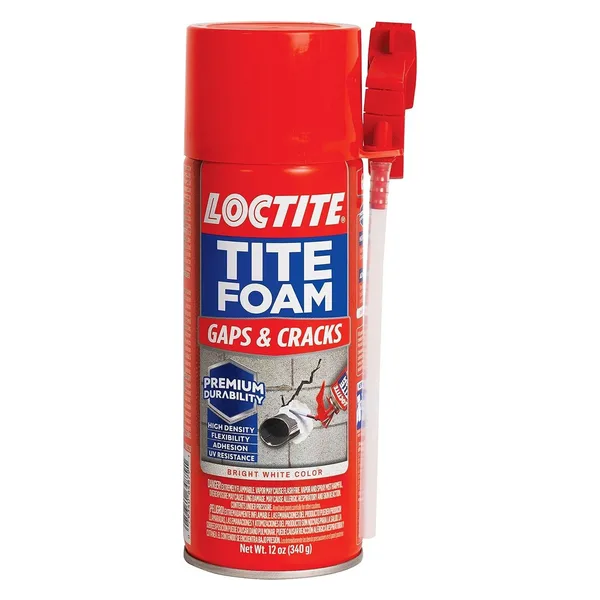
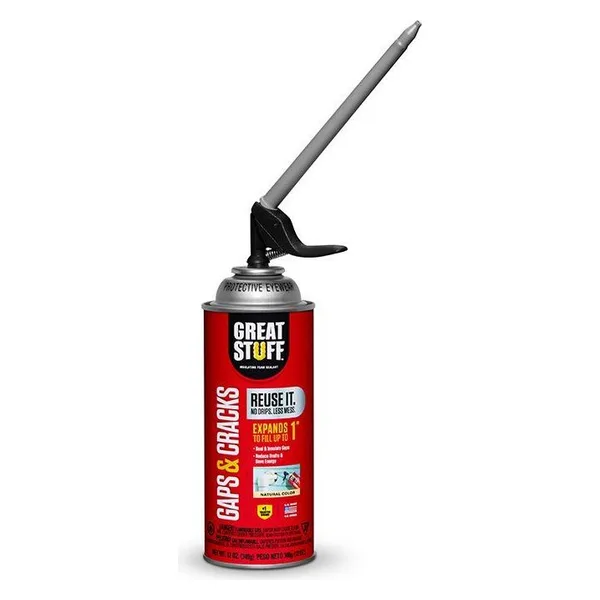
Side by side
Row by row, from the records
Every cell is read from the product record at build time, with the document it came from. A row marks one side only when both were measured the same way, or when only one maker put the figure in writing; everything else is printed without a mark.
| Row | Loctite Tite Foam Gaps & Cracks | Great Stuff Gaps & Cracks |
|---|---|---|
| Data sheet Only one of the two publishes a sheet | This one LOCTITE TITE FOAM Gaps & Cracks, technical data sheetJanuary 15, 2025 | No technical data sheet for this canPublished instead: safety data sheet, product page |
| Gap size | Up to 1 in; maximum joint width 1.6 in | Up to 1 in |
| Yield Only one of the two publishes it | This one About 134 ft of 3/8 in bead per 12 fl oz can, stated as a theoretical figure | Not published |
| Cured foam Only one of the two publishes it | This one Flexible solid, dimensional stability under 5 percent (TM 1004-2012) | Not published |
| Working temperature and cureBoth state the can temperature; read those lines against each other. | Ambient 23 to 95 F, can at 41 F or above; tack-free 6 to 8 min at 73 F and 50 percent RH | Interior and exterior, paint or cover outdoors; product temperature 60 to 90 FTack-free in 5 to 15 min at 70 F and 50 percent RH for a 1 in bead; trimmable in one hour |
| Fire wording | Not a fire stopping material, in the sheet’s own words | "UL classified" with no category and no file number, which is the same gap we flag on other brands |
| Seller on Amazon | Sold by Loctite (Henkel), the brand buyer. | Sold by DuPont, the brand buyer. |
| Amazon ratingA count of buyers who rated the listing, not a measure of the foam. | 4.4 from 21,814 ratingsOn the listing we link, read October 29, 2026 | 4.5 from 1,922 ratingsOn the listing we link, read October 29, 2026 |
| Open questions on the record | Loctite lists one size on Amazon under its own name. The Big Gaps sibling, rated to 3 in on its own sheet, was not in the intake.No R-value or thermal figure is published, which is appropriate for a gap filler and worth noticing when other cans print one. | The 20 oz can (item 157911) is not described on the brand site; its gap limit is assumed to match the 12 oz can and has not been confirmed. |
| Price per ounceNo same-pack comparison: one of the two showed no price on the listing we read. | No price on the listing we read | $53.99 for 12 x 12 oz, $0.37 an ounceAmazon, October 29, 2026 |
| Evidence checks More of the four checks confirmed | This one 4 of 4 checks confirmed#1 on the gap filler page | 2 of 4 checks confirmed#9 on the gap filler page |
Loctite Tite Foam Gaps & Cracks
No price we trust on the listings we read.
Great Stuff Gaps & Cracks
- 12 x 12 oz: $53.99
- 1 x 20 oz: $16.99
Where to look
The listings and the records
As an Amazon Associate I earn from qualifying purchases. That fee never sets the order or the score.
Loctite Tite Foam Gaps & Cracks
- Data sheet LOCTITE TITE FOAM Gaps & Cracks, technical data sheetJanuary 15, 2025
- Product page Loctite product page
Great Stuff Gaps & Cracks
- Safety data sheet Gaps and Cracks with Smart Dispenser, SDS 000001157441
- Product page Great Stuff Gaps & Cracks product page
What would change this
The missing piece, named
- A dated data sheet from DuPont for the consumer Gaps & Cracks can, with a yield and the conditions behind its 1 in claim, would close most of the distance between these two.
- A price for the Loctite can read on the same day as Great Stuff’s would let this page compare cost per ounce. On the day we read both listings, the Loctite listing showed no price.
Asked about this pair
Questions people type, answered from the records
What is the difference between Great Stuff and Loctite Tite Foam?
Both are consumer gap fillers stated for gaps up to 1 in, and the difference is what each maker puts in writing. Loctite publishes a data sheet dated January 15, 2025 with a maximum joint width of 1.6 in, a theoretical yield of about 134 ft of 3/8 in bead from a 12 fl oz can, a cured foam it describes as a flexible solid, and an ambient range of 23 to 95 F. DuPont publishes a 1 in gap limit and a tack-free time on its product page and no data sheet for this can. The cans differ too: the Loctite is a 12 fl oz trigger can, the Great Stuff a straw can in 12 and 20 oz.
Is Loctite Tite Foam better than Great Stuff?
On documentation, yes, and that is the only comparison this site makes: Loctite confirms four of our four evidence checks and Great Stuff two, because Great Stuff publishes no data sheet for this can. Neither foam has been sprayed or tested by us, so nothing here says which one performs better in a gap.
Which one works in cold weather?
Loctite states its range on the sheet: an ambient range of 23 to 95 F with the can at 41 F or above. DuPont states a product temperature of 60 to 90 F for Great Stuff, which is the can rather than the air. They are stated on different bases, so read each one as its own maker’s instruction rather than as two answers to one question.
Is either can fire rated?
No. The Loctite sheet says in its own words that the product is not a fire stopping material and should not be used where fireproof or fire stopping materials are required. The Great Stuff page says the can is UL classified without naming a category or a file number, which is a claim with nothing to look up. For a fireblocking location, our fire block page shows which cans carry a fireblocking evaluation with a report number.
How much does each one cost?
On the September 7, 2026 snapshot the cheapest bare pack we hold for Great Stuff is a case of 12 cans of 12 oz at $53.27, which is $0.37 an ounce. The Loctite listing we link showed no price on the day we read it, so there is no same-day figure to set against it, and the page says so rather than filling the gap with an older number.
How this page is built
Nothing here was sprayed by us
This comparison reads what each maker publishes and what the listings show; it is not a hands-on test. Every figure in the tables comes from the product records behind the full record pages, with the document it came from and the date we read it, and it changes on this page the day a record is re-read. A side is marked ahead only when both were measured the same way, or when only one maker put the figure in writing. The rules behind the order on the category pages are in the methodology.
Read next
Related pages
- Every gap filler we track, in evidence order
- Low-expansion foam for window and door frames
- Fire block foam, read by its fire paperwork
- Kraken Bond vs Great Stuff
- Akfix 805 vs Kraken Bond
- Great Stuff vs Great Stuff PRO
- Kraken Bond vs Stanley
- Kraken Bond vs Sprayman
- Kraken Bond vs BEEST
- Kraken Bond vs Akfix
- Akfix vs Stanley
- Open-cell vs closed-cell kits
- Can kits vs two-component kits
- Fire block foam vs regular foam
- Every comparison
A question this comparison does not answer? Ask the research desk
A question these pages do not answer yet? Send it to the desk. Questions are answered from the same records as every page here, the makers’ documents and the listings, and are not published as they are sent.
When the records can answer one, it becomes a question page with a dated note that a reader asked it. Your name and address are never published. We cannot answer every question, and we cannot judge one house we have not seen.
Tell us if something here is wrong
Everything on this page is a dated reading of documents that can change. If you make or sell this product, or you have read something here that is wrong, send the document. Every submission is read against the record; where it changes the record, the change is dated on the page, and where it does not, the reply says why. A submission cannot buy a position or remove a finding the documents still support, and what moves a record is written down.
Write to the research desk or copy research@beestsprayfoam.com