Best by project · Based on the 2021 IRC; your local code may differ

Best Spray Foam Insulation for Sound Control

Foam seals the air paths. It does not add mass, and mass is what stops sound.

Product examples · not ranked

The products on this page

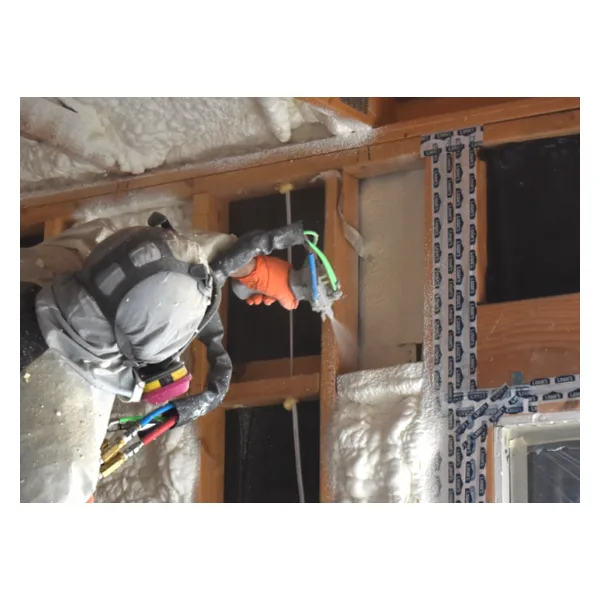
  1. HandiFoam Low Density (open cell) II-250, II-450 and II-1350 product photoHandiFoam Low Density (open cell) II-250, II-450 and II-1350See it on Amazon

As an Amazon Associate I earn from qualifying purchases.

Two different problems get sold under the word soundproofing. One is noise leaking through openings: the gap under a door, an unsealed outlet box, a duct that runs from one room into the next, a hole cut for a pipe. The other is sound going through the assembly itself, wall, floor or ceiling, where there is no hole at all. Foam is genuinely good at the first and modest at the second, and almost every product claim you will read blurs the two.

One product in our whole set publishes a sound figure tied to a test method; TYTAN prints 62 dB with no method named. The HandiFoam Low Density sheet, revision 6/2024, prints STC 35 in a stud wall with 3 in of foam and NRC 0.70 at 3 in, and describes the product as designed to "deaden sound or reduce vibration." It names the assembly type and the thickness, which is more than anyone else gives, though it does not name the test report. Against that: TYTAN states "62 dB sound-blocking" with no standard, no assembly and no test named, and a row of kits carry "heat and sound insulation" in the listing title with nothing at all behind it. That gap is the whole story of this category.

Assembly, moisture and code planning for this job is at our sister publication under common ownership: Insulation and sound-control evidence, at Spray Foam Guides. This page stays with exact products and the records their makers publish.

The assembly decides the product

What decides the product before you pick a brand

STC describes a wall, not a foam

Sound transmission class comes from testing a whole assembly to ASTM E90 and rating it to ASTM E413. It is a property of the wall that was built, not of any one material in it. HandiFoam prints STC 35 in "a stud wall," and the sheet does not give the stud size, the spacing or what was on each face, so there is no way to separate what the foam contributed from what the wall would have done empty. That is not a criticism of the number. It is what an STC number is.

NRC answers a different question

Noise reduction coefficient measures how much sound a surface absorbs rather than reflects. It is about echo and liveliness inside one room, not about what your neighbor hears. NRC 0.70 at 3 in is a real absorption figure and it is irrelevant to whether the television next door keeps you awake. The two get quoted together constantly and they are not the same claim.

Open cell is the one with the figures, and there is a reason

Open cell foam is soft and porous, which is what absorption inside a cavity needs. Closed cell is not, and the reason it does little for sound is not that it bridges the two faces: in an ordinary single-stud wall the studs already do that, and that path dominates. It is that a rigid, closed fill absorbs poorly and stiffens the air in the cavity, so measured results put it at or barely above an empty cavity while fibrous or open-cell fill does better. The only sound figures anywhere in our set belong to the open cell sheet, and among the products we tracked as of September 8, 2026, the only open cell ones are the two-component kits.

What the code says

The provisions that apply, and the numbers they use

Section numbers are from the 2021 International Residential Code. Your city or county adopts one edition of the code and changes parts of it, and your local building official has the final word. A thermal barrier and an ignition barrier are different things, and the glossary explains both.

Not the IRC: IBC 1206.2Walls and floor-ceiling assemblies separating dwelling units or sleeping units from each other, and from public and service areas such as corridors and stairs, are required to reach STC 50, or 45 when tested in the field. This is the apartment case. It reaches a townhouse only where that townhouse was built under the IBC, and most are built under the IRC instead. Nothing in a cavity meets it on its own.
The IRC sets no sound requirementInside a single-family house the residential code has nothing to say about sound between rooms. That means there is no test to pass and no inspector to satisfy, and it also means nobody is checking whether the product you bought does what the listing said.

Products that document this job

What the tracked products say about it, in their own documents

Listed by product family. Each line says why the product is on this list, always from something the maker published. Follow the link for the documents, the questions still open, and dated prices.

Canister systems

  • HandiFoam Low Density (open cell) The only product on this site with a published sound figure and a document behind it: STC 35 in a stud wall at 3 in and NRC 0.70 at 3 in, on a sheet dated 6/2024. It is also candid elsewhere, printing a Class B fire result as a Class B. Read the sheet before you buy it: it says FOR PROFESSIONAL USE ONLY and names a powered air purifying respirator.

Foam sealants

  • Gap and crack fillers The part of this job that reliably works. Outlet boxes on a shared wall, the gap where a pipe or duct crosses between rooms, the perimeter of a partition at the top plate. Cheap, checkable, and it removes the paths that make an assembly rating meaningless.

Single-can kits

  • The kits that claim sound without a number Several ranked and research-set kits carry "heat and sound insulation" or a decibel figure in their marketing. None publishes a standard, an assembly or a test. The ranking page shows what each one does and does not document.
Where foam is not the answer
  • A party wall, a shared floor or anything that has to reach a rating. STC 50 is an assembly result and it comes from mass, from decoupling the two faces so they do not share studs, and from damping. In a plain single-stud wall the cavity fill moves it a few points and no more. Be careful reading that as a general rule though, because it inverts once the wall is decoupled: a staggered-stud or double-stud wall gains a lot from cavity absorption and does not reach its rated number empty. The fill is not the thing that gets you to 50, and it is not optional once you are building for 50 either.
  • Footsteps from the floor above. Impact noise is a different measurement again, and it is solved under the finish floor with a resilient layer or by decoupling the ceiling below. Foam in the joist bays does very little for it.
  • Echo inside a room you are already in. That is surface absorption, which means panels on the wall, and spray foam is not a finished surface. It also cannot be left exposed in occupied space without the barrier the code asks for.
  • A wall you have already opened up, if the goal is a quieter room and the budget is fixed. A second layer of board, a damping compound between the two, or resilient channel will each do more for the same money than filling the cavity will.

Quantity, worked once

One interior partition, 12 ft by 8 ft, between a bedroom and a living room

Board feet are square feet times inches. The kit figures are the makers’ theoretical yields, which every maker that defines the term says are laboratory numbers; plan on less.

  1. Wall area 96 sq ft
  2. At 3 in, the thickness the STC figure names: 288 board feet
  3. HandiFoam II-250 claims 250 board feet, II-450 claims 450
  4. The alternative: three 4 by 8 sheets of 5/8 in board per layer for 96 sq ft, with damping compound between the layers, which adds the mass an STC number moves on

One II-450 kit covers it on the maker figure, and what you buy is the STC 35 the sheet names for its own test wall. That sheet also says professional use only and names a powered air purifying respirator, which is worth pricing in. Before spending it, seal the outlet boxes and the top plate, because an unsealed box will undo more than the foam adds. If the wall is open and quiet is the actual goal, price a second layer of board against the kit and compare.

Run your own numbers in the calculator

Questions

Sound Control, answered from the records above

Does spray foam soundproof a wall?

It seals it, which is not the same thing and is often more useful. Air paths carry noise directly, and foam closes them. What it does not do is add mass to the assembly, and mass is what stops airborne sound going through a wall that has no holes in it. The one published figure in our set is STC 35 for an open cell foam in a stud wall at 3 in, and STC 35 is a modest number for a partition.

Open cell or closed cell for sound?

Open cell, on the evidence. It is soft and porous, which is what sound absorption needs, and it is the only cell type with a published figure in our set. Closed cell is rigid, and a rigid fill couples the two faces of a partition rather than isolating them. If a listing sells closed cell foam on a sound claim, ask what standard the claim was measured to.

What actually lowers the noise between two rooms?

Three things, in this order. Seal every opening, which is where foam earns its place. Add mass, usually a second layer of board. Then decouple, so the two faces of the wall do not share the same studs, using staggered studs, a double wall, resilient channel or isolation clips. A damping compound between two layers of board adds to that. Cavity absorption belongs with them rather than instead of them: it does little on its own in a single-stud wall and a lot inside a decoupled one.

From the job to the finished wall

Plan the job in five questions

  1. Where are you insulating?

    This page answers it for sound control. The same five questions run for every other part of the house.

  2. What will it cost?

    Board feet are the area times the thickness. Price the kits that cover them against hiring the job out.

  3. What do you need?

    A kit, the gun and cleaner it works with, something to cover what stays clean, and the gear you wear.

  4. How do you do it?

    Check the temperature, prepare the surface, spray in passes and cover the foam where people live.

  5. How long does it take?

    The sheets give a tack-free time in minutes and a full cure in hours; only some say when people can go back in.

We have not sprayed or tested any product on this page, and nothing here stands in for the label, the safety data sheet or what your local inspector tells you.