Layer thickness
The tracked kits describe one layer at 1 in. Thicker walls are built in passes, and the yield claim is per pass at the rated distance.
Best by project · Based on the 2021 IRC; your local code may differ
Is the wall open or closed, and how many inches do you actually have?
Product examples · not ranked
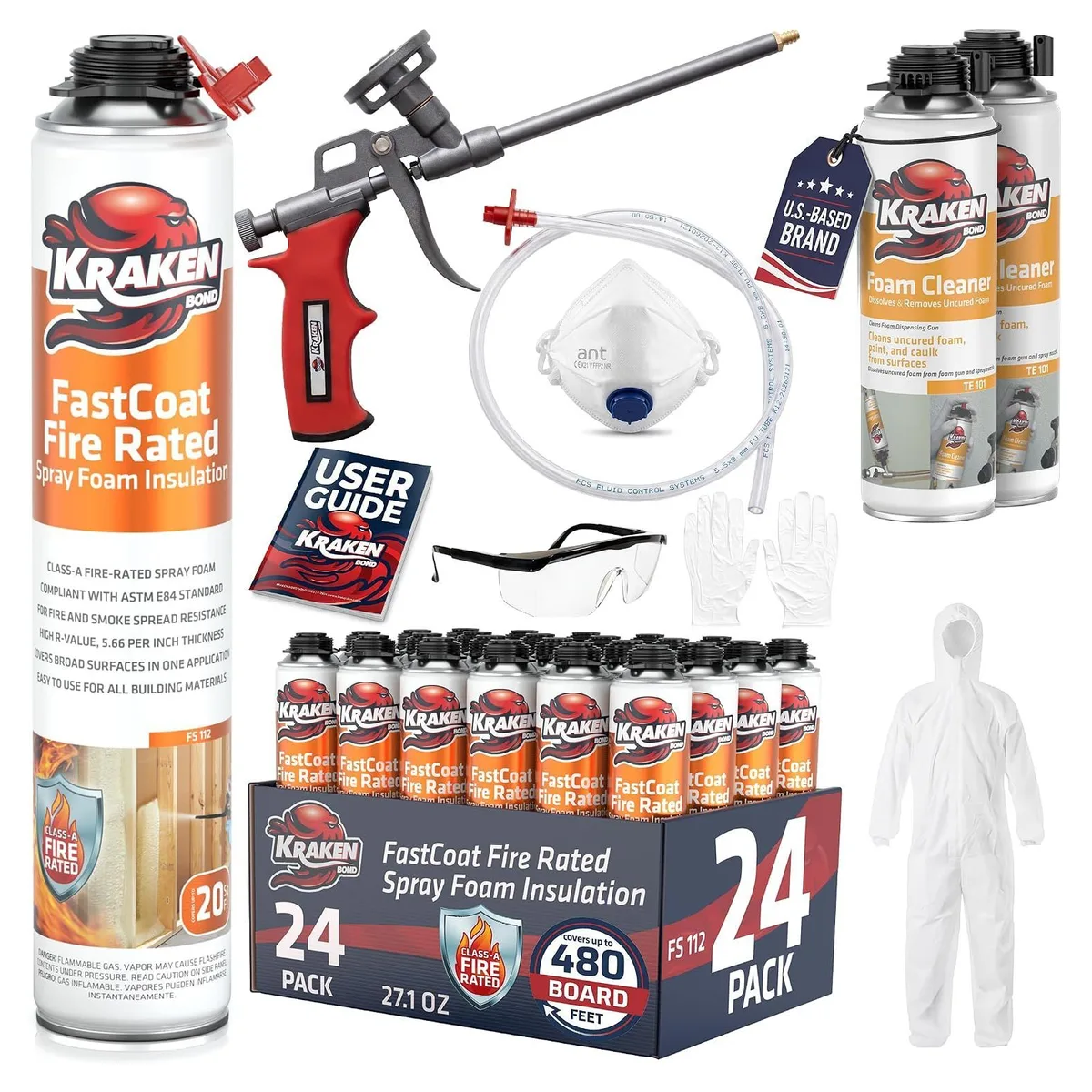 Kraken Bond FastCoat 24-PackSee it on Amazon
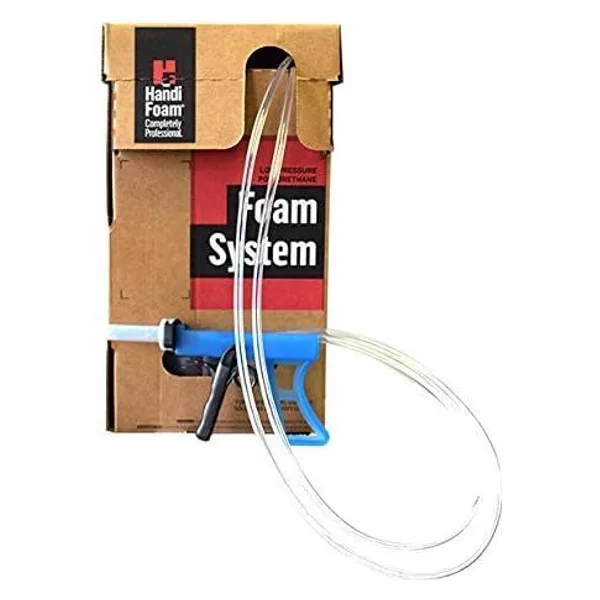 HandiFoam FR (HFO) II-200 and II-600See it on Amazon
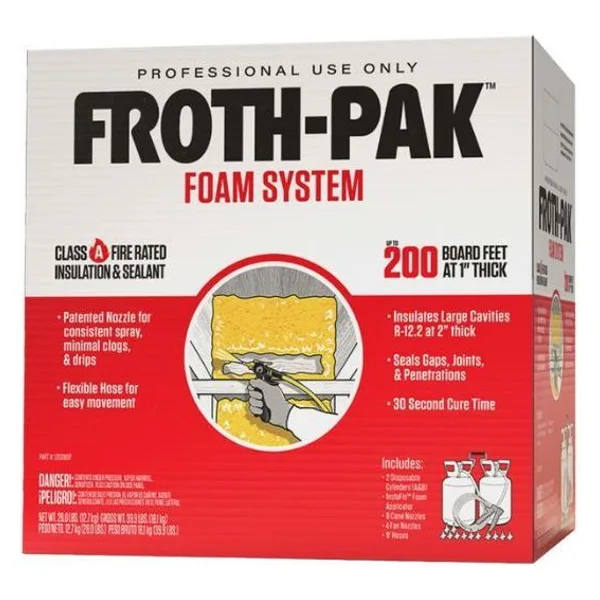 DuPont Froth-Pak 200 Foam SystemSee it on Amazon
As an Amazon Associate I earn from qualifying purchases.
An open stud wall is the one job every single-can kit is sold for: a 2x4 or 2x6 cavity with the studs exposed, sprayed in layers and then covered with drywall. A closed wall, with drywall or plaster already on, is a different product class; cans cannot fill it and the makers who serve that job offer slow-rise injection kits instead.
The number that decides the purchase is cavity depth times area. A 2x4 bay is 3.5 in deep; the kits on this site claim 20 board feet per can at 1 in, so one can covers 20 sq ft at 1 in or 10 sq ft at 2 in, before the yield loss every maker warns about.
Assembly, moisture and code planning for this job is at our sister publication under common ownership: Exterior-wall assembly planning, at Spray Foam Guides. This page stays with exact products and the records their makers publish.
The assembly decides the product
The tracked kits describe one layer at 1 in. Thicker walls are built in passes, and the yield claim is per pass at the rated distance.
The 2021 IRC generally asks for a qualifying thermal barrier between foam plastic and the interior: 1/2 in gypsum board, 23/32 in wood structural panel, or a material that meets the acceptance criteria of both fire tests in NFPA 275. Drywall does that job. Leaving the foam bare depends on an exception or an approved assembly, so read the adopted code and the product’s own report before you plan on it.
The recommended wall values in our calculator, from DOE and ENERGY STAR guidance, run R-13 in zones 1 and 2, R-20 in zones 3 to 5 and R-21 in zones 6 to 8. The 2021 IECC prescriptive wall table is a separate document with its own cavity and continuous-insulation options, and your jurisdiction may have adopted a different edition, so read the adopted table before you size anything. What a filled 3.5 in bay is worth thermally is the number none of these makers publish. They print a value per inch, and US rules restrict that form because resistance per inch falls as foam gets thicker, so multiplying one out to bay depth invents a result no test supports. Ask the maker for a value measured at the depth you plan to fill.
What the code says
Section numbers are from the 2021 International Residential Code. Your city or county adopts one edition of the code and changes parts of it, and your local building official has the final word. A thermal barrier and an ignition barrier are different things, and the glossary explains both.
Products that document this job
Listed by product family. Each line says why the product is on this list, always from something the maker published. Follow the link for the documents, the questions still open, and dated prices.
Quantity, worked once
Board feet are square feet times inches. The kit figures are the makers’ theoretical yields, which every maker that defines the term says are laboratory numbers; plan on less.
One 24-can kit claims enough for about three such walls at 2 in, or 1.7 walls filled full depth, on the makers’ own theoretical figure. Plan for less.
Run your own numbers in the calculatorQuestions
Not where the code applies a thermal barrier, which is most interior walls. The 2021 IRC R316.4 asks for 1/2 in gypsum board, 23/32 in wood structural panel, or a material that meets the acceptance criteria of both fire tests in NFPA 275 between foam plastic and the room. Some limited-access spaces take an ignition barrier instead, and R316.6 allows an assembly approved on the basis of an end-use test. Ask the local official before you decide the foam is the finish.
As thick as the target requires and the bay allows, which for a 2x4 is 3.5 in. What that depth reaches, we cannot tell you and neither can the label: every canned kit in our set publishes a value per inch, and a per-inch value multiplied out to bay depth is arithmetic rather than a measurement. Resistance per inch falls as foam gets thicker, which is why the per-inch form is restricted in the first place. Ask the maker for a figure measured at 3.5 in, with the method and aging basis behind it, then read the energy code your jurisdiction adopted, which is a separate table.
It is faster and cures in seconds, and HandiFoam and Froth-Pak both list walls. It is also a professional-use product by the makers’ own words, with a longer PPE list and higher isocyanate exposure during spraying. For a few walls a can kit is simpler, and on the stated figures it is also cheaper: about 0.66 to 0.81 dollars a claimed board foot against 1.25 to 2.05 for the canisters. What the canister buys at scale is not a lower price. It is a yield figure the maker defines in print, a much faster application, and one setup instead of twenty-four cans.
Usually not, and in some assemblies it does harm. Closed cell foam at enough thickness is already a vapor retarder, and the number that says so is the perm rating the maker publishes at the thickness you sprayed. HandiFoam FR prints 0.9 perm at 1 in. Adding sheet plastic on the warm side of a wall that already has a low-perm layer can trap water between the two. Read the perm rating on your product, then ask what your adopted code requires for your zone.
From the job to the finished wall
This page answers it for walls. The same five questions run for every other part of the house.
Board feet are the area times the thickness. Price the kits that cover them against hiring the job out.
A kit, the gun and cleaner it works with, something to cover what stays clean, and the gear you wear.
Check the temperature, prepare the surface, spray in passes and cover the foam where people live.
The sheets give a tack-free time in minutes and a full cure in hours; only some say when people can go back in.
We have not sprayed or tested any product on this page, and nothing here stands in for the label, the safety data sheet or what your local inspector tells you.